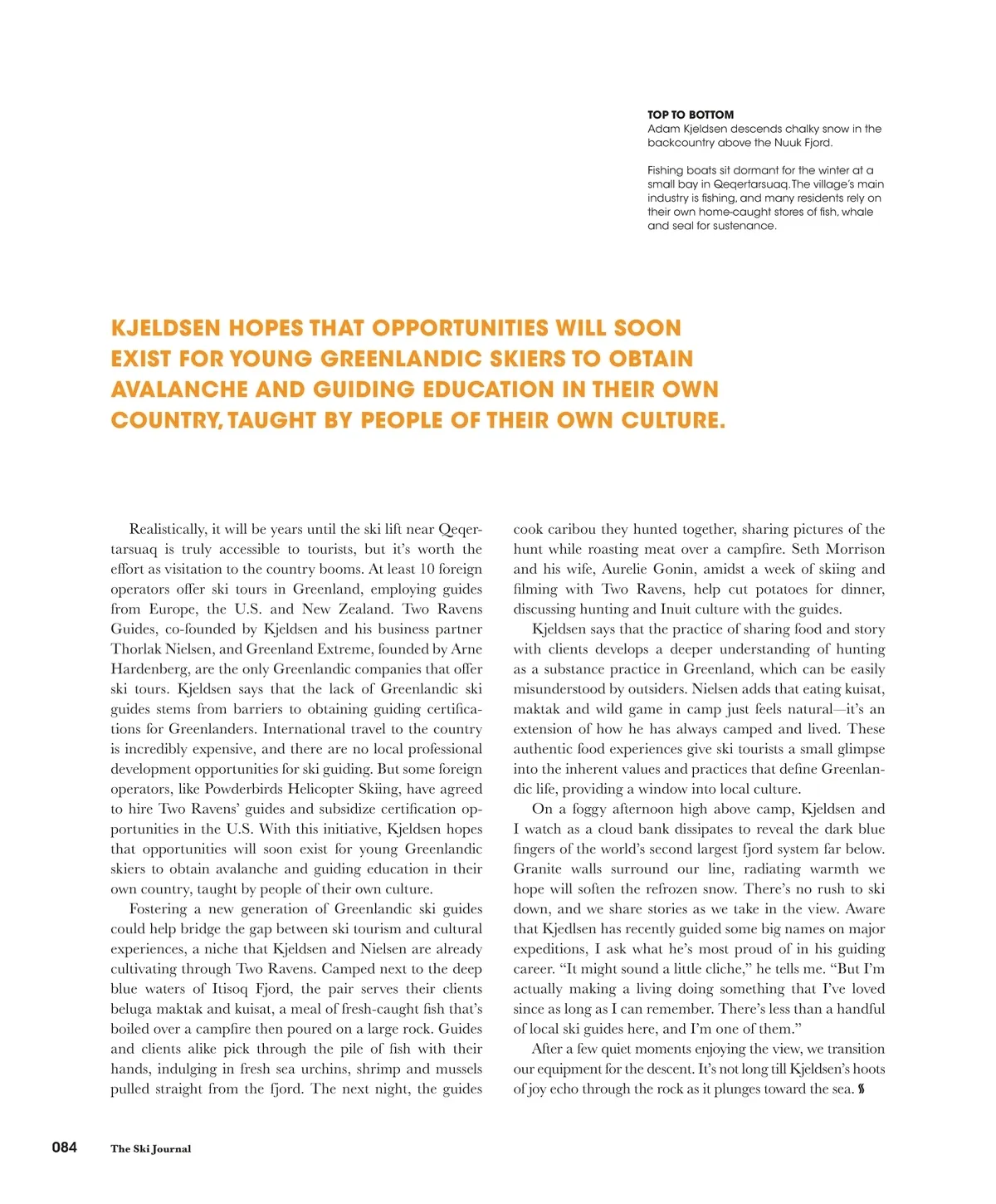
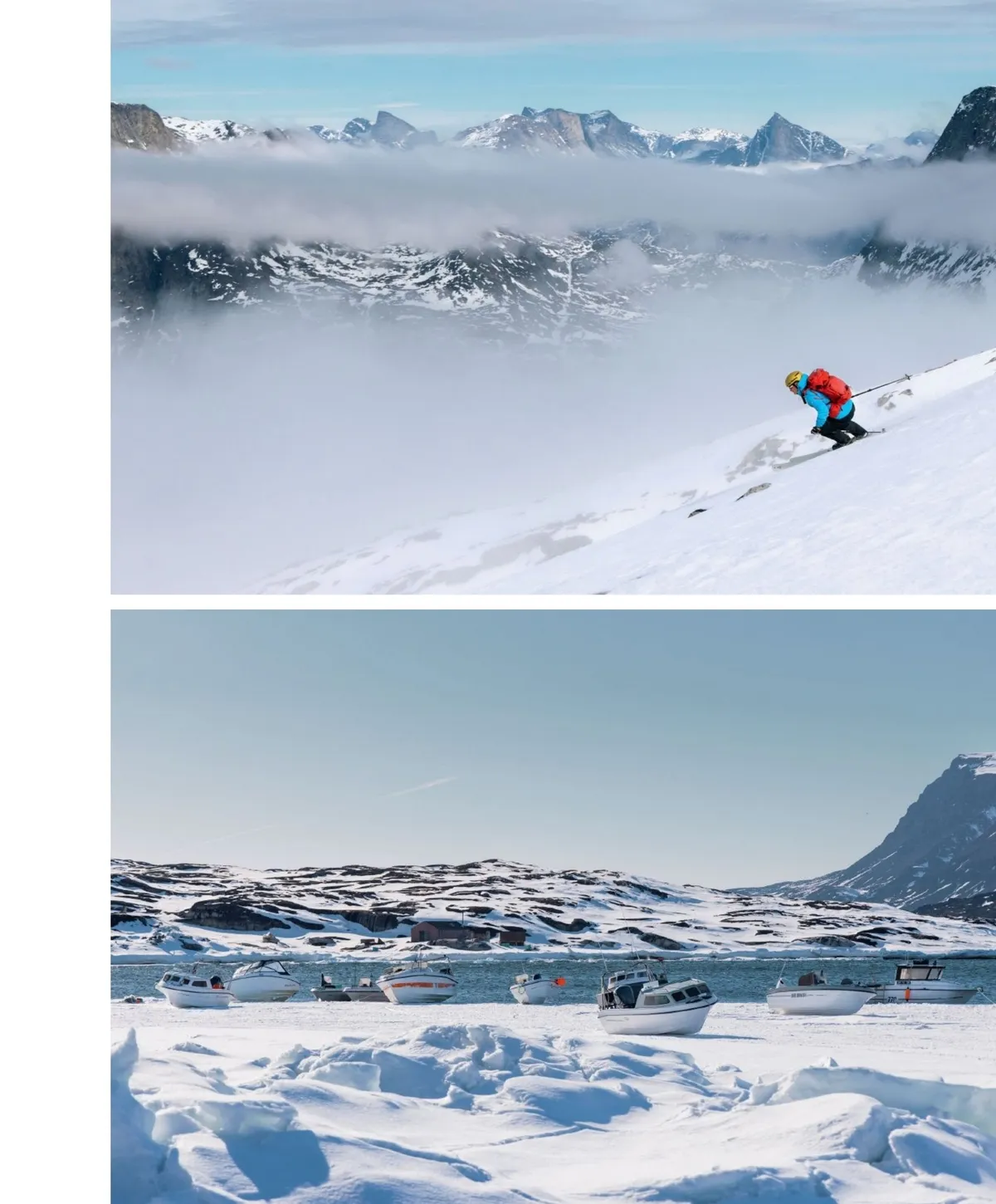
TOP TO BOTTOM Adam Kjeldsen descends chalky snow in the backcountry above the Nuuk Fjord. Fishing boats sit dormant for the winter at a small bay in Qeqertarsuaq. The village’s main industry is fishing, and many residents rely on their own home-caught stores of fish, whale and seal for sustenance. KJELDSEN HOPES THAT OPPORTUNITIES WILL SOON EXIST FOR YOUNG GREENLANDIC SKIERS TO OBTAIN AVALANCHE AND GUIDING EDUCATION IN THEIR OWN COUNTRY, TAUGHT BY PEOPLE OF THEIR OWN CULTURE. Realistically, it will be years until the ski lift near Qeqer-tarsuaq is truly accessible to tourists, but it’s worth the effort as visitation to the country booms. At least 10 foreign operators offer ski tours in Greenland, employing guides from Europe, the U.S. and New Zealand. Two Ravens Guides, co-founded by Kjeldsen and his business partner Thorlak Nielsen, and Greenland Extreme, founded by Arne Hardenberg, are the only Greenlandic companies that offer ski tours. Kjeldsen says that the lack of Greenlandic ski guides stems from barriers to obtaining guiding certifica-tions for Greenlanders. International travel to the country is incredibly expensive, and there are no local professional development opportunities for ski guiding. But some foreign operators, like Powderbirds Helicopter Skiing, have agreed to hire Two Ravens’ guides and subsidize certification op-portunities in the U.S. With this initiative, Kjeldsen hopes that opportunities will soon exist for young Greenlandic skiers to obtain avalanche and guiding education in their own country, taught by people of their own culture. Fostering a new generation of Greenlandic ski guides could help bridge the gap between ski tourism and cultural experiences, a niche that Kjeldsen and Nielsen are already cultivating through Two Ravens. Camped next to the deep blue waters of Itisoq Fjord, the pair serves their clients beluga maktak and kuisat, a meal of fresh-caught fish that’s boiled over a campfire then poured on a large rock. Guides and clients alike pick through the pile of fish with their hands, indulging in fresh sea urchins, shrimp and mussels pulled straight from the fjord. The next night, the guides cook caribou they hunted together, sharing pictures of the hunt while roasting meat over a campfire. Seth Morrison and his wife, Aurelie Gonin, amidst a week of skiing and filming with Two Ravens, help cut potatoes for dinner, discussing hunting and Inuit culture with the guides. Kjeldsen says that the practice of sharing food and story with clients develops a deeper understanding of hunting as a substance practice in Greenland, which can be easily misunderstood by outsiders. Nielsen adds that eating kuisat, maktak and wild game in camp just feels natural—it’s an extension of how he has always camped and lived. These authentic food experiences give ski tourists a small glimpse into the inherent values and practices that define Greenlan-dic life, providing a window into local culture. On a foggy afternoon high above camp, Kjeldsen and I watch as a cloud bank dissipates to reveal the dark blue fingers of the world’s second largest fjord system far below. Granite walls surround our line, radiating warmth we hope will soften the refrozen snow. There’s no rush to ski down, and we share stories as we take in the view. Aware that Kjedlsen has recently guided some big names on major expeditions, I ask what he’s most proud of in his guiding career. “It might sound a little cliche,” he tells me. “But I’m actually making a living doing something that I’ve loved since as long as I can remember. There’s less than a handful of local ski guides here, and I’m one of them.” After a few quiet moments enjoying the view, we transition our equipment for the descent. It’s not long till Kjeldsen’s hoots of joy echo through the rock as it plunges toward the sea. 084 The Ski Journal
The Ski Journal Volume 17, Issue 3: Page 84