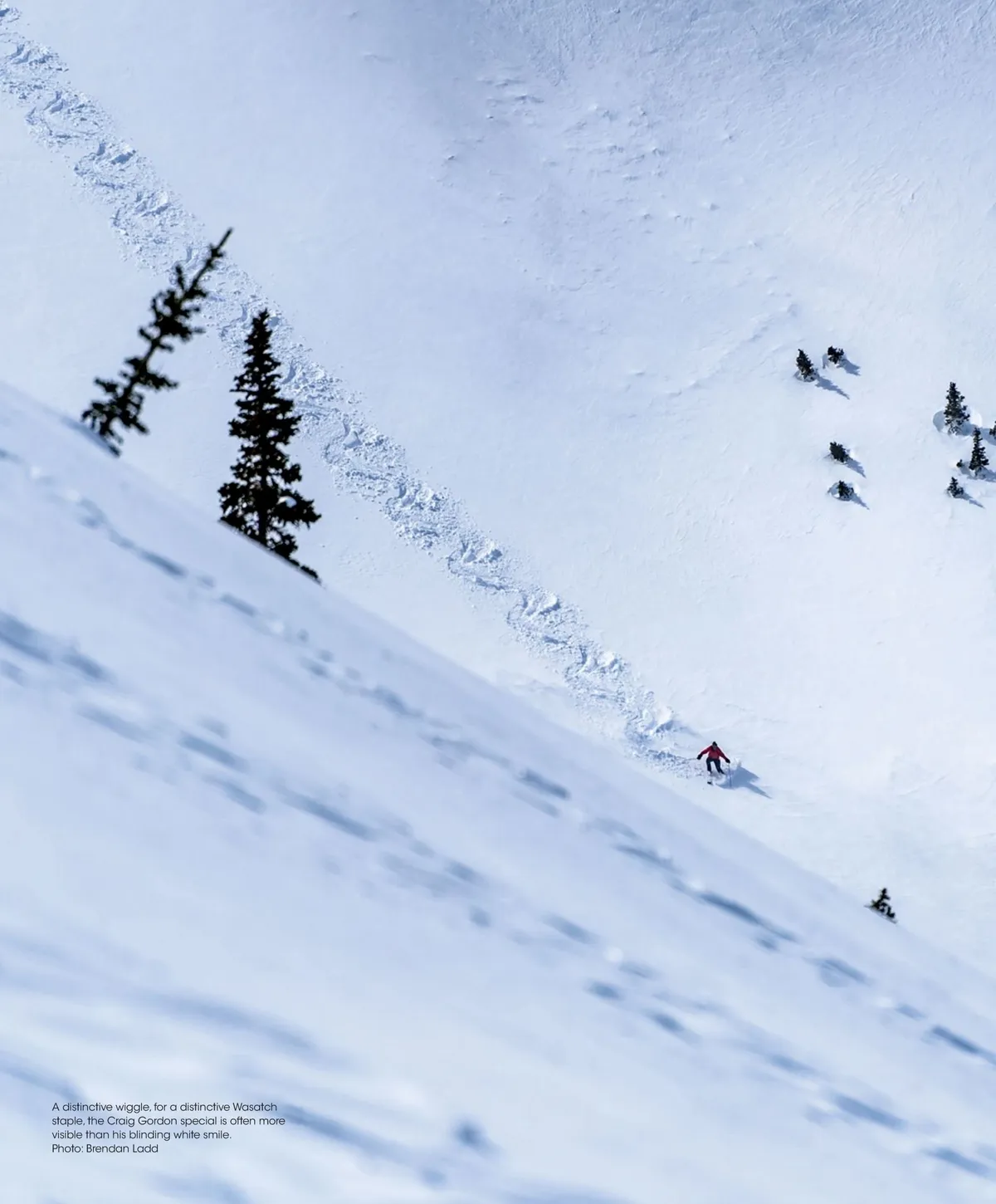
CRAIG GORDON’S EDUCATIONAL ENTERTAINMENT STRAIGHT LINE Words MEGAN MICHELSON I’D HEARD Utah’s Uinta range had a persistent weak layer, that wobbly sliver in the snowpack that makes slopes more prone to avalanches. It was early March, and I was on my way into a backcountry yurt in the region, so I’d started reading the Utah Avalanche Center’s daily forecasts for that range weeks before my trip. Beyond education, I found my-self strangely captivated. The writing was quirky and funny in a way that somber avalanche forecasts rarely are. “Remember the big dry spell during January/February? (You’re thinking to yourself... hmmm, I forget what time I dropped the kids off for soccer practice today),” the fore-caster wrote one day. “Well, that midwinter drought helped create a weak layer of faceted, sugary snow which is now buried under several layers’ worth of storm snow from last week. And while we might forget everyday occurrences, the snowpack has an amazing memory. In fact, now that this layer is buried, it’s our new problem child.” The analyst with the sharp wit? Craig Gordon, an enigmatic staffer at the Utah Avalanche Center for the last 25 years. Gordon, 61, has a gray buzzcut paired with a high-top manbun and what looks like an orange spray tan. He wears gold hoop earrings and sometimes posts videos with a pet parrot named Baby. He seldom wears a hat or goggles and he’s always on telemark gear he’s picked up at a yard sale or ski swap. Instead of counting the days he skis, he counts the days he doesn’t. (He usually skis about 200 a year.) Most days, Gordon wakes at 2 a.m. to get his daily forecast posted by 5 a.m. During those hours, he drinks espresso with a heaping scoop of instant coffee, before working out in his home gym. When he’s in the field col-lecting observations, he’s not much of a note taker, but he does have a near-photographic memory. Gordon grew up surfing on New Jersey’s Long Beach Island. At 15, a friend invited him on a ski trip to Alta, UT. He remembers riding the chairlift and seeing ski patrollers making their way across the untracked Ballroom and an-nouncing to his friend, “I’m coming back here to do that .” He wound up at the University of Utah for a stint and scored a night job dishwashing at Snowbird. “Skiing overtook my life,” he recalls. “Much to my parents’ displeasure, I told them I’m staying in Utah to be a ski patrolman. That was unheard of in the culture I grew up in.” He got his EMT certification and eventually got hired onto the patrol squad at Utah’s Brighton ski area, where he worked for a decade. In a class at the University of Utah on snow dynamics, Gordon sat rapt listening to one of the ava-lanche forecasters who worked for the department of trans-portation in Little Cottonwood Canyon. “A lightbulb went off. I’m like, you can make a living forecasting avalanches?” he says. When a position opened in the mid-1990s as snow safety director for a startup heli-ski operation in the Uintas, a mountain range outside of Park City, Gordon left Brighton behind and jumped at the chance. The Uintas are a lesser-known range that stretch east to west for about 150 miles. While most backcountry skiers in Utah flock to the Wasatch, the Uintas have remained relatively untouched. “There was no information from that zone. It was a complete black hole since very few people recreated there,” Gordon says. The Uintas have a different snowpack than the Wasatch: It’s more continental, like Colorado, with a generally shal-lower, weaker and more dangerous structure. “The Wasatch gets its fair share of avalanches, but the continental zones are always on the edge of failure,” Gordon says. “That same structure is very tricky for backcountry users and forecasters.” The Ski Journal 037
The Ski Journal Volume 17, Issue 4: Page 37