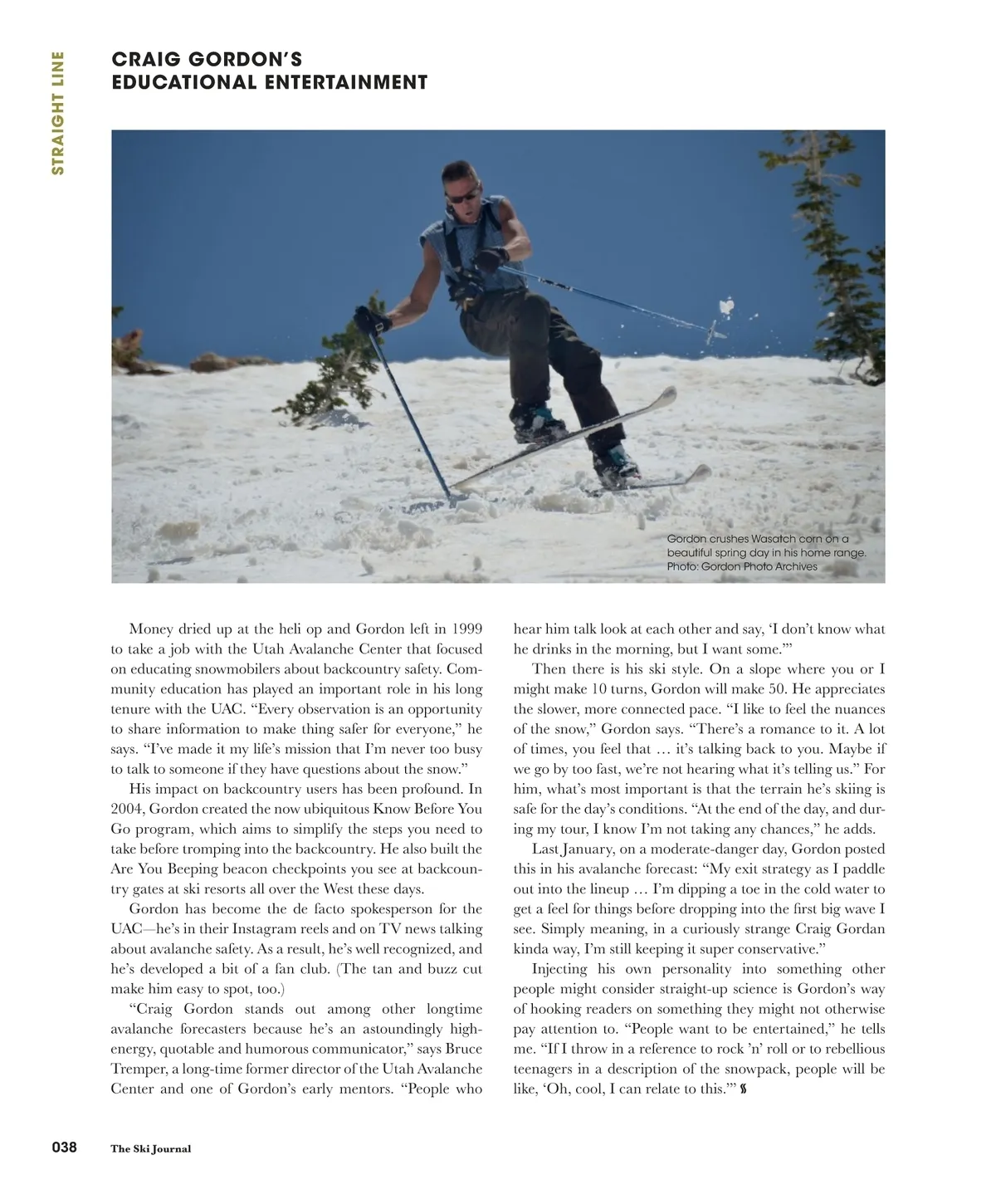
STRAIGHT LINE CRAIG GORDON’S EDUCATIONAL ENTERTAINMENT Gordon crushes Wasatch corn on a beautiful spring day in his home range. Photo: Gordon Photo Archives Money dried up at the heli op and Gordon left in 1999 to take a job with the Utah Avalanche Center that focused on educating snowmobilers about backcountry safety. Com-munity education has played an important role in his long tenure with the UAC. “Every observation is an opportunity to share information to make thing safer for everyone,” he says. “I’ve made it my life’s mission that I’m never too busy to talk to someone if they have questions about the snow.” His impact on backcountry users has been profound. In 2004, Gordon created the now ubiquitous Know Before You Go program, which aims to simplify the steps you need to take before tromping into the backcountry. He also built the Are You Beeping beacon checkpoints you see at backcoun-try gates at ski resorts all over the West these days. Gordon has become the de facto spokesperson for the UAC—he’s in their Instagram reels and on TV news talking about avalanche safety. As a result, he’s well recognized, and he’s developed a bit of a fan club. (The tan and buzz cut make him easy to spot, too.) “Craig Gordon stands out among other longtime avalanche forecasters because he’s an astoundingly high-energy, quotable and humorous communicator,” says Bruce Tremper, a long-time former director of the Utah Avalanche Center and one of Gordon’s early mentors. “People who hear him talk look at each other and say, ‘I don’t know what he drinks in the morning, but I want some.’” Then there is his ski style. On a slope where you or I might make 10 turns, Gordon will make 50. He appreciates the slower, more connected pace. “I like to feel the nuances of the snow,” Gordon says. “There’s a romance to it. A lot of times, you feel that … it’s talking back to you. Maybe if we go by too fast, we’re not hearing what it’s telling us.” For him, what’s most important is that the terrain he’s skiing is safe for the day’s conditions. “At the end of the day, and dur-ing my tour, I know I’m not taking any chances,” he adds. Last January, on a moderate-danger day, Gordon posted this in his avalanche forecast: “My exit strategy as I paddle out into the lineup … I’m dipping a toe in the cold water to get a feel for things before dropping into the first big wave I see. Simply meaning, in a curiously strange Craig Gordan kinda way, I’m still keeping it super conservative.” Injecting his own personality into something other people might consider straight-up science is Gordon’s way of hooking readers on something they might not otherwise pay attention to. “People want to be entertained,” he tells me. “If I throw in a reference to rock ’n’ roll or to rebellious teenagers in a description of the snowpack, people will be like, ‘Oh, cool, I can relate to this.’” 038 The Ski Journal
The Ski Journal Volume 17, Issue 4: Page 38