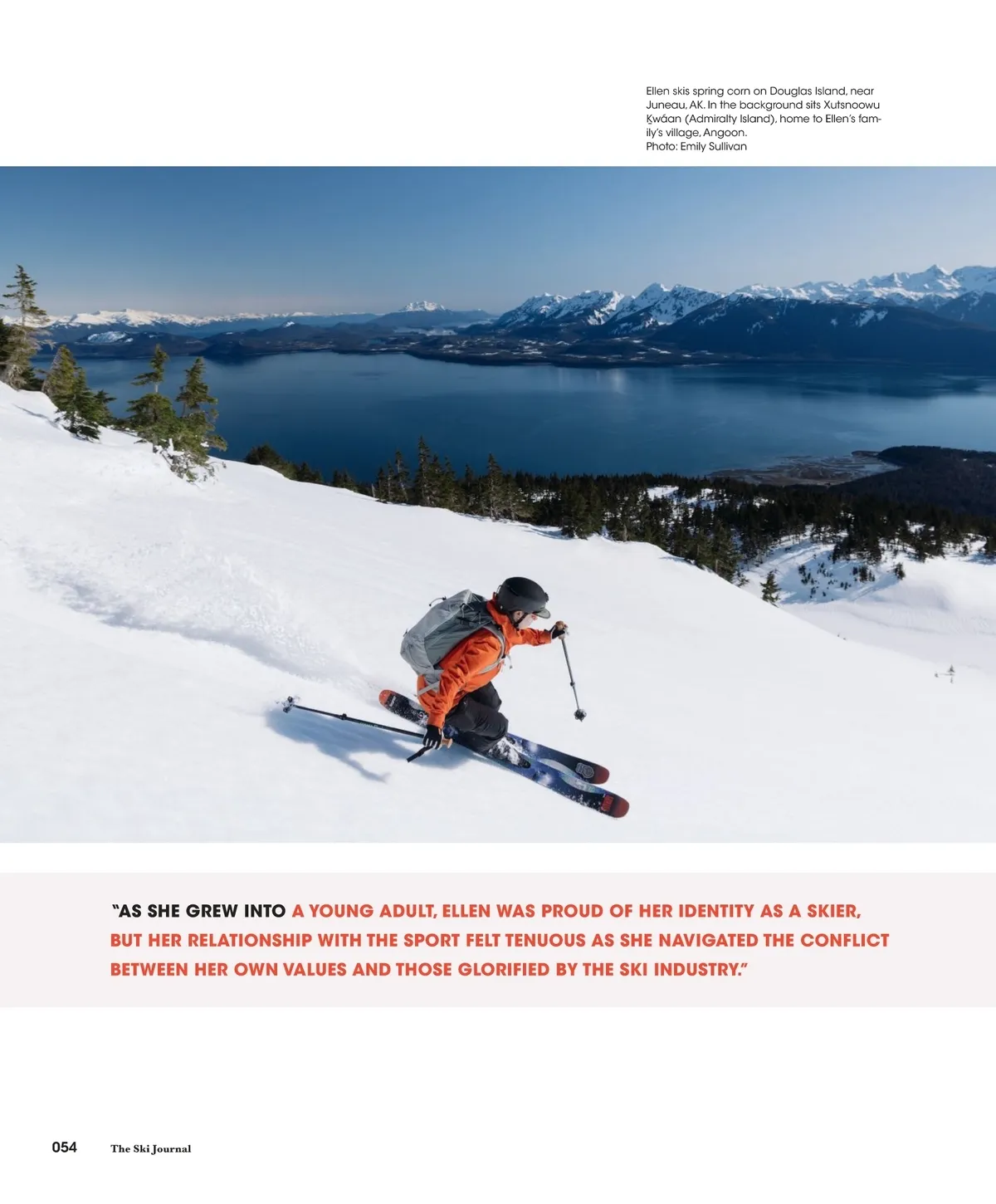
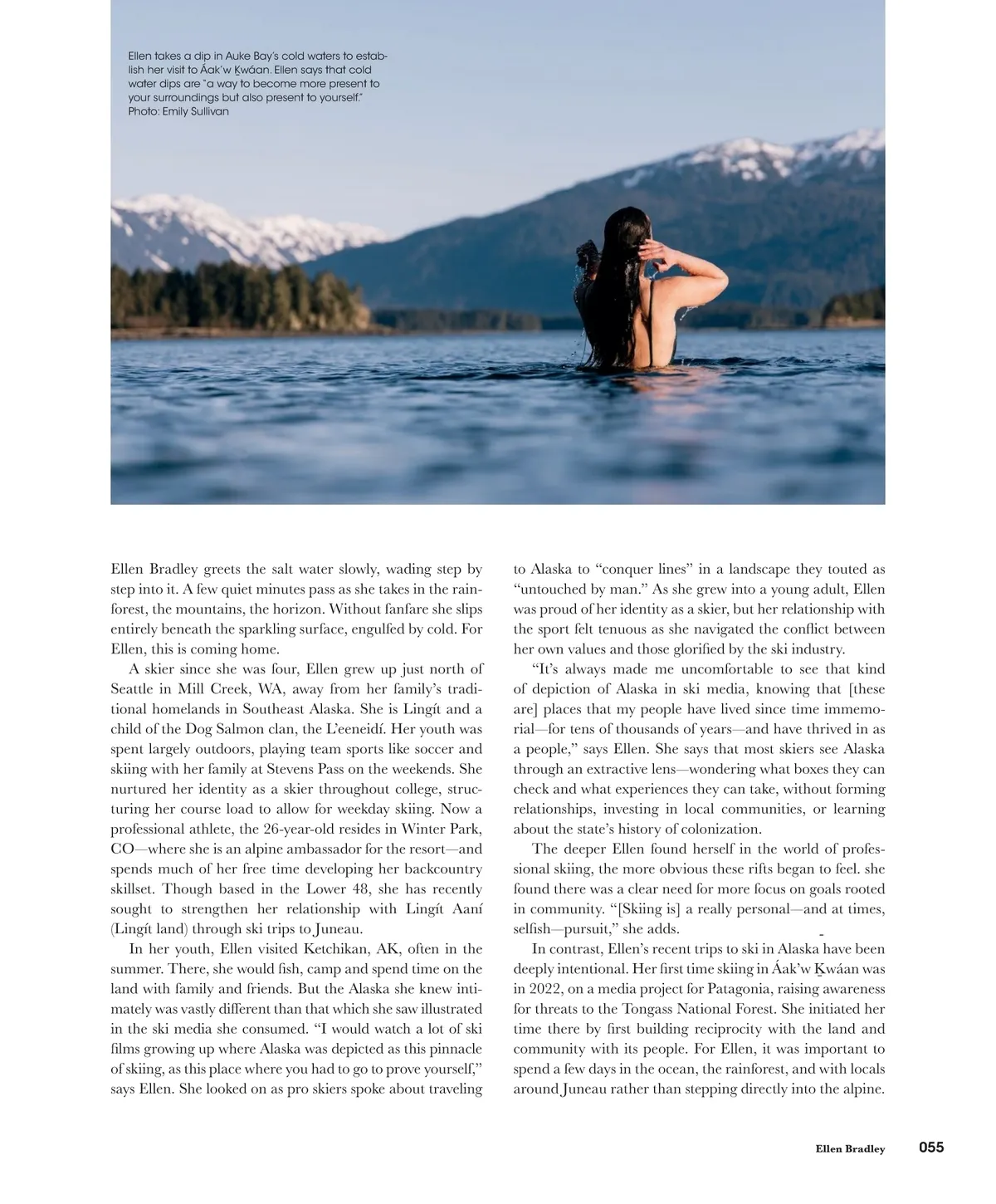
Ellen takes a dip in Auke Bay’s cold waters to estab-lish her visit to Áak’w Kwáan. Ellen says that cold water dips are “a way to become more present to your surroundings but also present to yourself.” Photo: Emily Sullivan Ellen Bradley greets the salt water slowly, wading step by step into it. A few quiet minutes pass as she takes in the rain-forest, the mountains, the horizon. Without fanfare she slips entirely beneath the sparkling surface, engulfed by cold. For Ellen, this is coming home. A skier since she was four, Ellen grew up just north of Seattle in Mill Creek, WA, away from her family’s tradi-tional homelands in Southeast Alaska. She is Lingít and a child of the Dog Salmon clan, the L’eeneidí. Her youth was spent largely outdoors, playing team sports like soccer and skiing with her family at Stevens Pass on the weekends. She nurtured her identity as a skier throughout college, struc-turing her course load to allow for weekday skiing. Now a professional athlete, the 26-year-old resides in Winter Park, CO—where she is an alpine ambassador for the resort—and spends much of her free time developing her backcountry skillset. Though based in the Lower 48, she has recently sought to strengthen her relationship with Lingít Aaní (Lingít land) through ski trips to Juneau. In her youth, Ellen visited Ketchikan, AK, often in the summer. There, she would fish, camp and spend time on the land with family and friends. But the Alaska she knew inti-mately was vastly different than that which she saw illustrated in the ski media she consumed. “I would watch a lot of ski films growing up where Alaska was depicted as this pinnacle of skiing, as this place where you had to go to prove yourself,” says Ellen. She looked on as pro skiers spoke about traveling to Alaska to “conquer lines” in a landscape they touted as “untouched by man.” As she grew into a young adult, Ellen was proud of her identity as a skier, but her relationship with the sport felt tenuous as she navigated the conflict between her own values and those glorified by the ski industry. “It’s always made me uncomfortable to see that kind of depiction of Alaska in ski media, knowing that [these are] places that my people have lived since time immemo-rial—for tens of thousands of years—and have thrived in as a people,” says Ellen. She says that most skiers see Alaska through an extractive lens—wondering what boxes they can check and what experiences they can take, without forming relationships, investing in local communities, or learning about the state’s history of colonization. The deeper Ellen found herself in the world of profes-sional skiing, the more obvious these rifts began to feel. she found there was a clear need for more focus on goals rooted in community. “[Skiing is] a really personal—and at times, selfish—pursuit,” she adds. In contrast, Ellen’s recent trips to ski in Alaska have been deeply intentional. Her first time skiing in ÎIS¼_ʫ_nIV was in 2022, on a media project for Patagonia, raising awareness for threats to the Tongass National Forest. She initiated her time there by first building reciprocity with the land and community with its people. For Ellen, it was important to spend a few days in the ocean, the rainforest, and with locals around Juneau rather than stepping directly into the alpine. Ellen Bradley 055
The Ski Journal Volume 18, Issue 1: Page 55