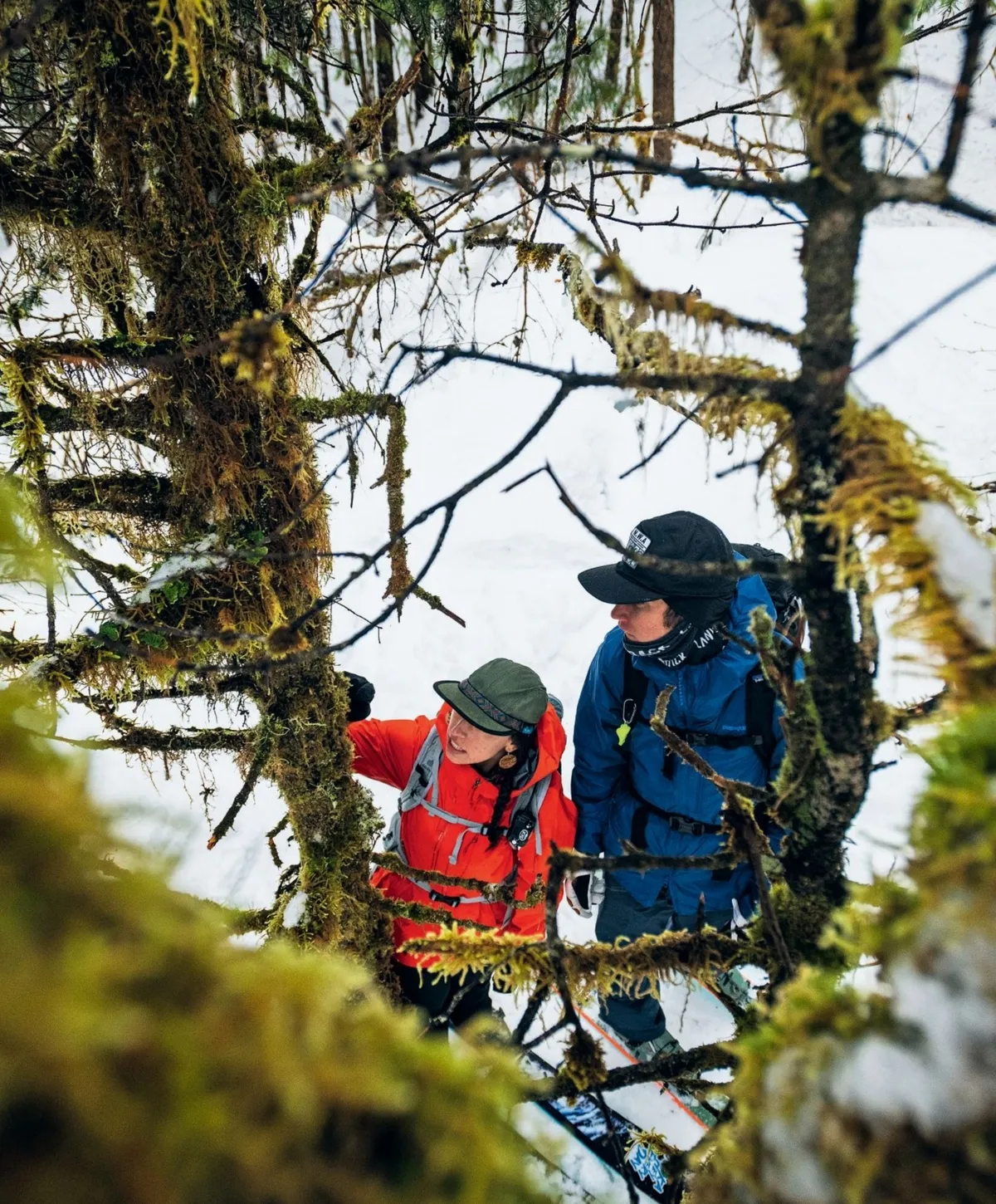
Ellen, a Lingít skier and scientist, exam-ines moss in the lush temperate forests of Juneau, AK. Photo: Matthew Tufts With an undergraduate degree in environmental studies and biology and professional background as an ecologist, Ellen experiences Áak’w ʫ_nIV landscape through both an Indigenous and a scientific lens, seeking to comprehend the nuanced connections between humans and ecosystems. As we walk in the dappled sunlight of the rainforest’s edge, she points out various epiphytes by name, explaining their rela-tionships to the trees that host them. When we emerge onto the adjacent beach, Ellen shares that her favorite aspect of Lingít Aaní is its diversity of ecosystems. “I don’t think I’ve ever been to another place that has the ocean touching the rainforest touching the mountains to the alpine,” she says. The cold-water dip, a traditional Lingít practice, serves as an important reintroduction to the land on each of Ellen’s visits. “It’s a way to become present to your sur-roundings, but also present to yourself in the moment,” she explains. “Traditionally, it was a practice we used to build strength for hunting … so I felt like it was a way to be present with the land and to work on the strength and bravery that it takes to come home to lands that you’ve been separated from.” On her early visits to Juneau, Ellen was struck by how few Indigenous skiers were present at Eaglecrest, the local, non-profit ski area on Sayéik, or Douglas Island. She knew that one of the most powerful ways she could engage with the local community was by creating more access on the hill for Alaska Native people. The Douglas Indian As-sociation was in the process of establishing a ski program for local Indigenous middle-and high-school students, but local parents underscored the need for programming for younger Indigenous kids. Deeply aware of how impactful skiing can be at a young age, Ellen worked with local ski-ers, snowboarders and the local tribal government—the Central Council of Tlingit and Haida—to establish a youth snowsports camp for third-through fifth-grade tribal mem-bers in 2023. The following year, Ellen moved to Juneau for the win-ter, working to develop the spring break snowsports camp for native youth. She also got to experience the full range of skiing in Southeast Alaska—from deep powder days to rain to long windows of high pressure. She felt her level of connection to Áak’w ʫ_nIV deepen with each passing experience. This year, the Tlingit and Haida spring break camp hosts fifteen youth who are excited to arrive at Eaglecrest under the glaringly bright March sun. Ellen greets each child by name as they arrive at the day lodge, making sure that they have the gear they need. Eventually, the students break out into small groups with Eaglecrest instructors at the helm, practicing pizza wedges and parallel turns on the bunny slope before venturing onto bigger blue and green runs. Ellen expertly juggles the logistics of the event while also finding time to take a few runs with the students during their afternoon freeski session, encouraging them with fist bumps and high fives. Eleven-year-old Amari is trying skiing for the first time today, and she is eager to graduate from the bunny hill. After lunch, Ellen helps her navigate over to the intermediate chair, Hooter, where she can try her new skills out on a larger slope. She tows Amari across the flats to access the two-seater lift which will deposit them midway up the mountain. Despite a few falls, Amari is all smiles and pride at the bottom of her first “big” run. The tribe provides lessons, lunch and rentals to the camp’s participants, ensuring that families can focus on the fun aspects of skiing without shouldering the burden of affordability and logistics. “This sport is happening on our land, so I wanted to start with the youth, to dismantle some of those barriers to access,” says Ellen. It allows those kids to connect with the land and figure out if this is a way they enjoy moving their body.” The Tlingit and Haida camp is just one example of Ellen’s ongoing work to increase Indigenous access and rep-resentation in the world of skiing. Ellen says that her life and work as an athlete look quite different than that of most pro skiers—while she does speaking engagements, photoshoots, and spends as much of her time skiing as possible, her work is always aimed at returning Native people to the land. “Being on the land will allow us to have better connection to our own values, recognizing where our tribal values are being upheld or not. And then finding agency to establish and situate our own tribal values and protocols on how to be on our land,” Ellen explains. She says that reciprocity is an Indigenous value that is sorely lacking from mainstream outdoor culture. Conquering language is ever-present in skiing in particular—“peak bagging” or “smash-and-grab” missions reinforce the mindset of human dominance over landscapes. 056 The Ski Journal
The Ski Journal Volume 18, Issue 1: Page 56