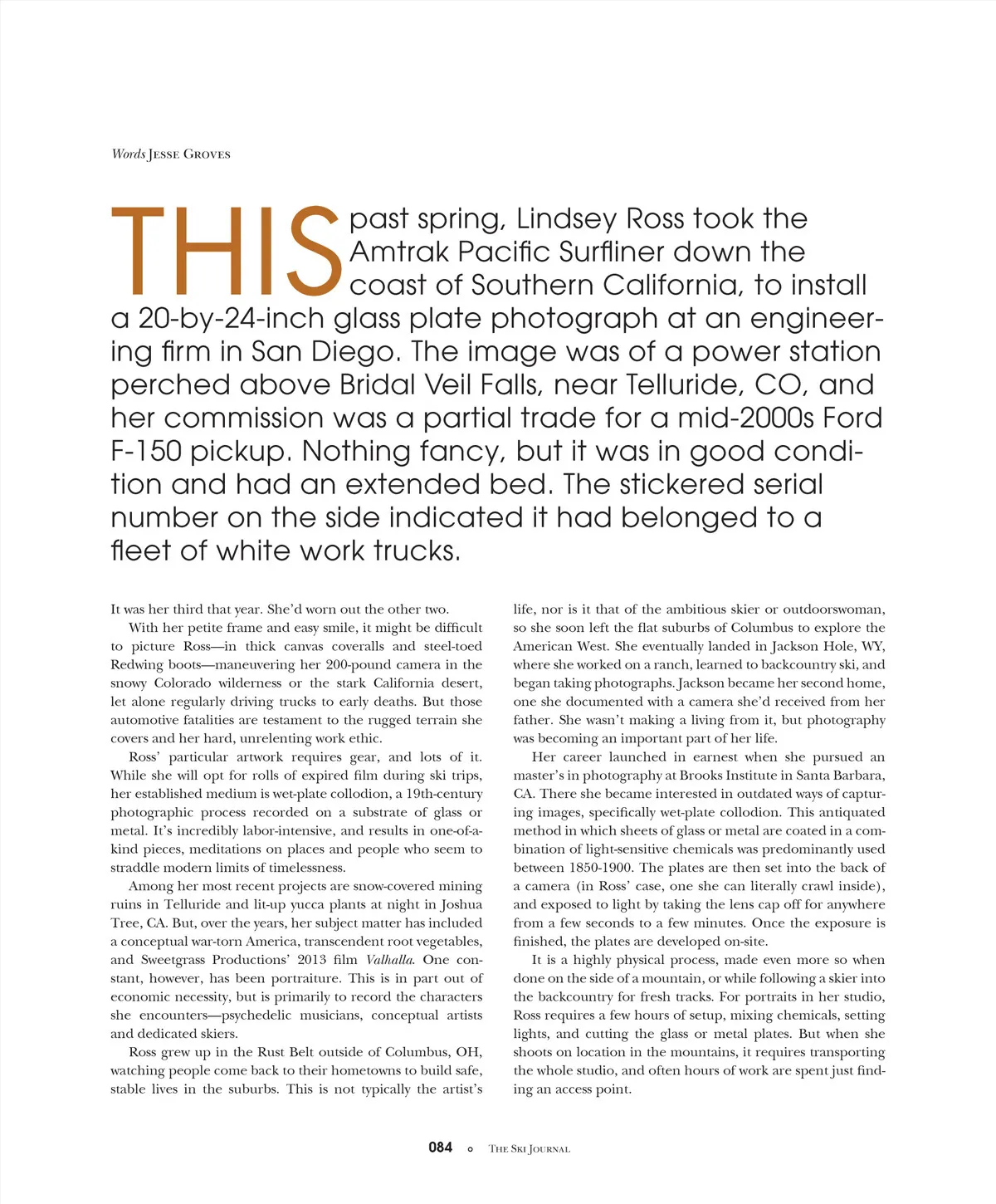
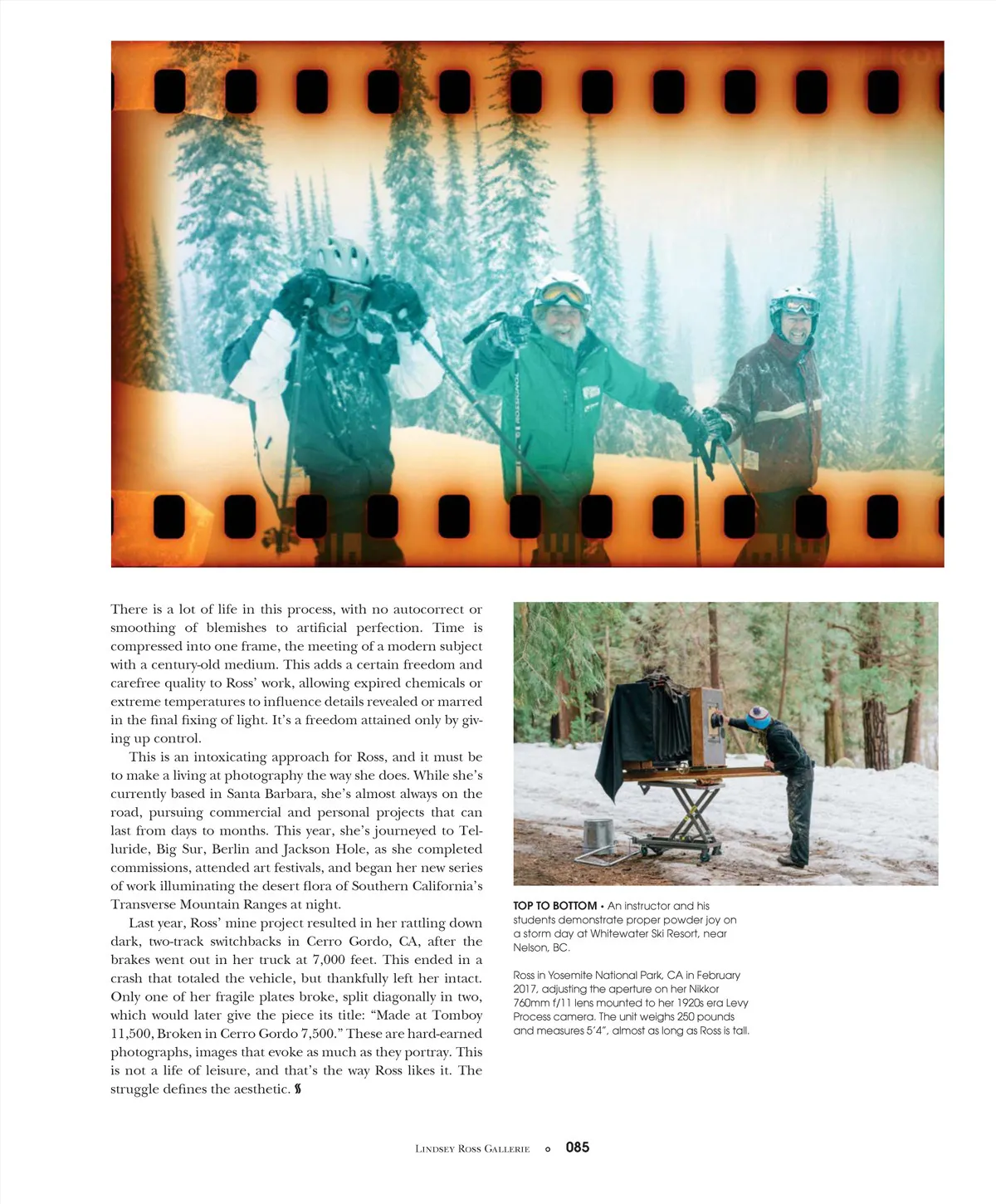
Words Jesse Groves past spring, Lindsey Ross took the Amtrak Pacific Surfliner down the coast of Southern California, to install a 20-by-24-inch glass plate photograph at an engineer-ing firm in San Diego. The image was of a power station perched above Bridal Veil Falls, near Telluride, CO, and her commission was a partial trade for a mid-2000s Ford F-150 pickup. Nothing fancy, but it was in good condi-tion and had an extended bed. The stickered serial number on the side indicated it had belonged to a fleet of white work trucks. It was her third that year. She’d worn out the other two. With her petite frame and easy smile, it might be difficult to picture Ross—in thick canvas coveralls and steel-toed Redwing boots—maneuvering her 200-pound camera in the snowy Colorado wilderness or the stark California desert, let alone regularly driving trucks to early deaths. But those automotive fatalities are testament to the rugged terrain she covers and her hard, unrelenting work ethic. Ross’ particular artwork requires gear, and lots of it. While she will opt for rolls of expired film during ski trips, her established medium is wet-plate collodion, a 19th-century photographic process recorded on a substrate of glass or metal. It’s incredibly labor-intensive, and results in one-of-a-kind pieces, meditations on places and people who seem to straddle modern limits of timelessness. Among her most recent projects are snow-covered mining ruins in Telluride and lit-up yucca plants at night in Joshua Tree, CA. But, over the years, her subject matter has included a conceptual war-torn America, transcendent root vegetables, and Sweetgrass Productions’ 2013 film Valhalla . One con-stant, however, has been portraiture. This is in part out of economic necessity, but is primarily to record the characters she encounters—psychedelic musicians, conceptual artists and dedicated skiers. Ross grew up in the Rust Belt outside of Columbus, OH, watching people come back to their hometowns to build safe, stable lives in the suburbs. This is not typically the artist’s life, nor is it that of the ambitious skier or outdoorswoman, so she soon left the flat suburbs of Columbus to explore the American West. She eventually landed in Jackson Hole, WY, where she worked on a ranch, learned to backcountry ski, and began taking photographs. Jackson became her second home, one she documented with a camera she’d received from her father. She wasn’t making a living from it, but photography was becoming an important part of her life. Her career launched in earnest when she pursued an master’s in photography at Brooks Institute in Santa Barbara, CA. There she became interested in outdated ways of captur-ing images, specifically wet-plate collodion. This antiquated method in which sheets of glass or metal are coated in a com-bination of light-sensitive chemicals was predominantly used between 1850-1900. The plates are then set into the back of a camera (in Ross’ case, one she can literally crawl inside), and exposed to light by taking the lens cap off for anywhere from a few seconds to a few minutes. Once the exposure is finished, the plates are developed on-site. It is a highly physical process, made even more so when done on the side of a mountain, or while following a skier into the backcountry for fresh tracks. For portraits in her studio, Ross requires a few hours of setup, mixing chemicals, setting lights, and cutting the glass or metal plates. But when she shoots on location in the mountains, it requires transporting the whole studio, and often hours of work are spent just find-ing an access point. THIS 084 The Ski Journal
The Ski Journal Volume Eleven, Issue Four: Page 84