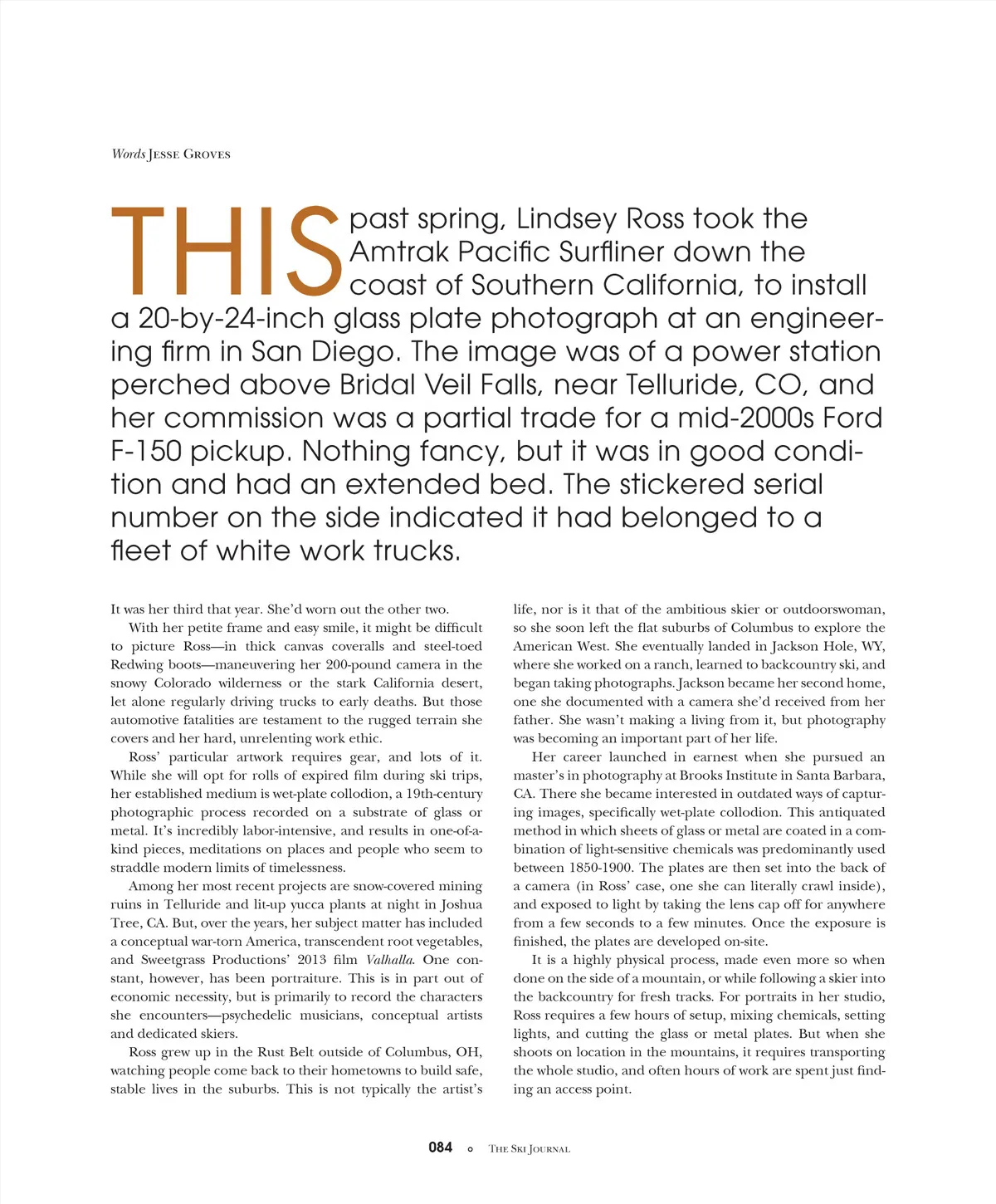
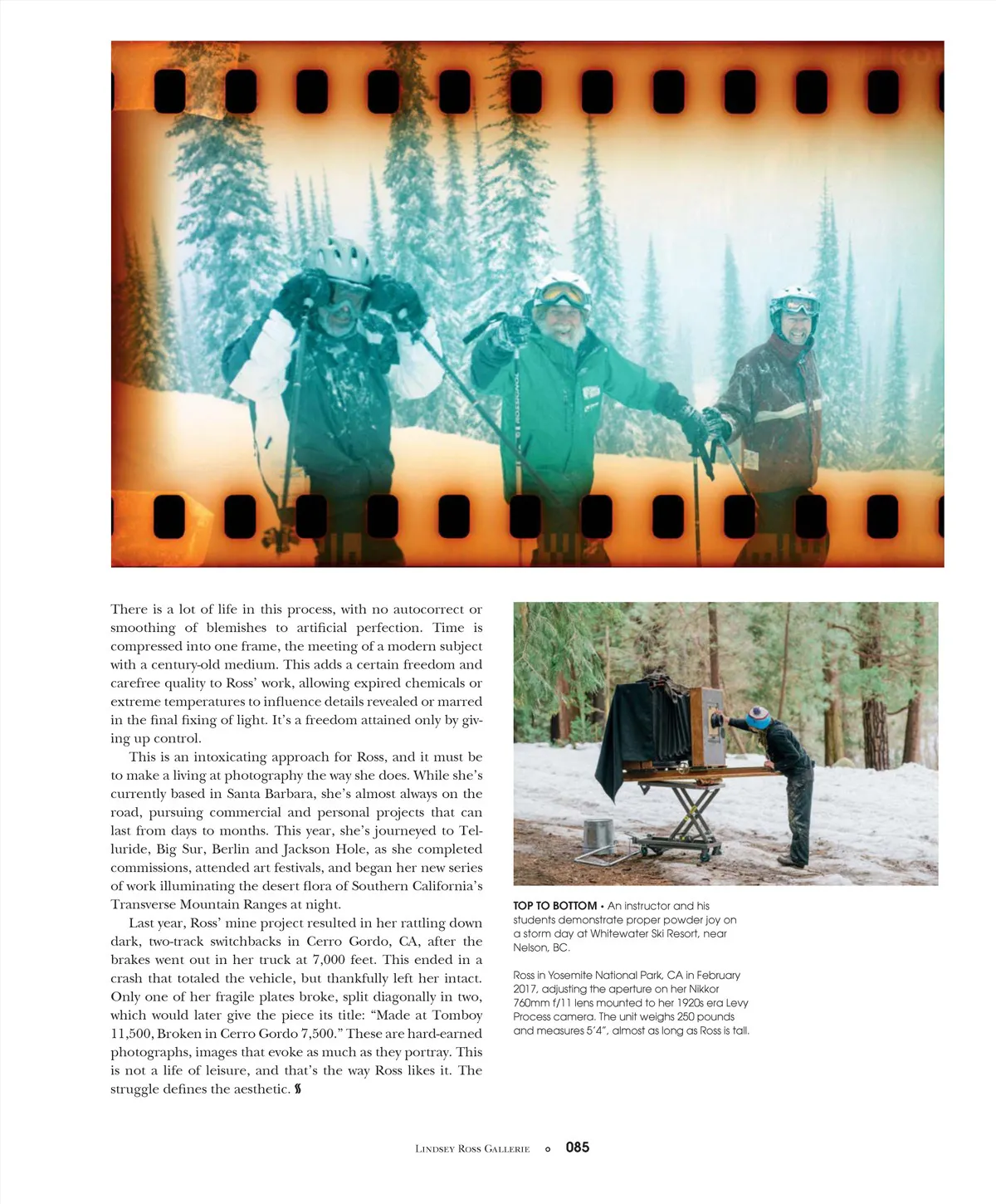
There is a lot of life in this process, with no autocorrect or smoothing of blemishes to artificial perfection. Time is compressed into one frame, the meeting of a modern subject with a century-old medium. This adds a certain freedom and carefree quality to Ross’ work, allowing expired chemicals or extreme temperatures to influence details revealed or marred in the final fixing of light. It’s a freedom attained only by giv-ing up control. This is an intoxicating approach for Ross, and it must be to make a living at photography the way she does. While she’s currently based in Santa Barbara, she’s almost always on the road, pursuing commercial and personal projects that can last from days to months. This year, she’s journeyed to Tel-luride, Big Sur, Berlin and Jackson Hole, as she completed commissions, attended art festivals, and began her new series of work illuminating the desert flora of Southern California’s Transverse Mountain Ranges at night. Last year, Ross’ mine project resulted in her rattling down dark, two-track switchbacks in Cerro Gordo, CA, after the brakes went out in her truck at 7,000 feet. This ended in a crash that totaled the vehicle, but thankfully left her intact. Only one of her fragile plates broke, split diagonally in two, which would later give the piece its title: “Made at Tomboy 11,500, Broken in Cerro Gordo 7,500.” These are hard-earned photographs, images that evoke as much as they portray. This is not a life of leisure, and that’s the way Ross likes it. The struggle defines the aesthetic. TOP TO BOTTOM • An instructor and his students demonstrate proper powder joy on a storm day at Whitewater Ski Resort, near Nelson, BC. Ross in Yosemite National Park, CA in February 2017, adjusting the aperture on her Nikkor 760mm f/11 lens mounted to her 1920s era Levy Process camera. The unit weighs 250 pounds and measures 5’4”, almost as long as Ross is tall. Lindsey Ross Gallerie 085
The Ski Journal Volume Eleven, Issue Four: Page 85