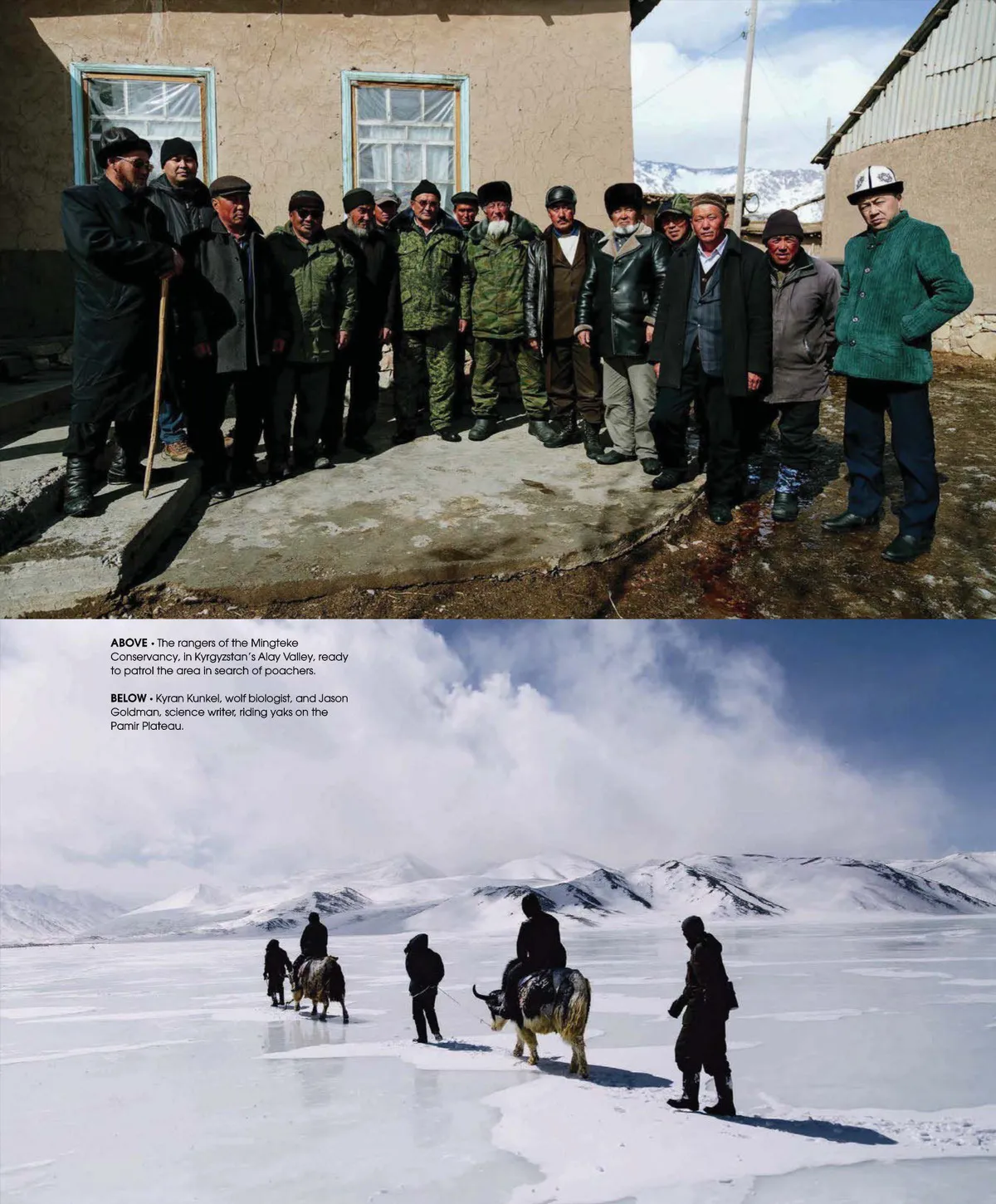
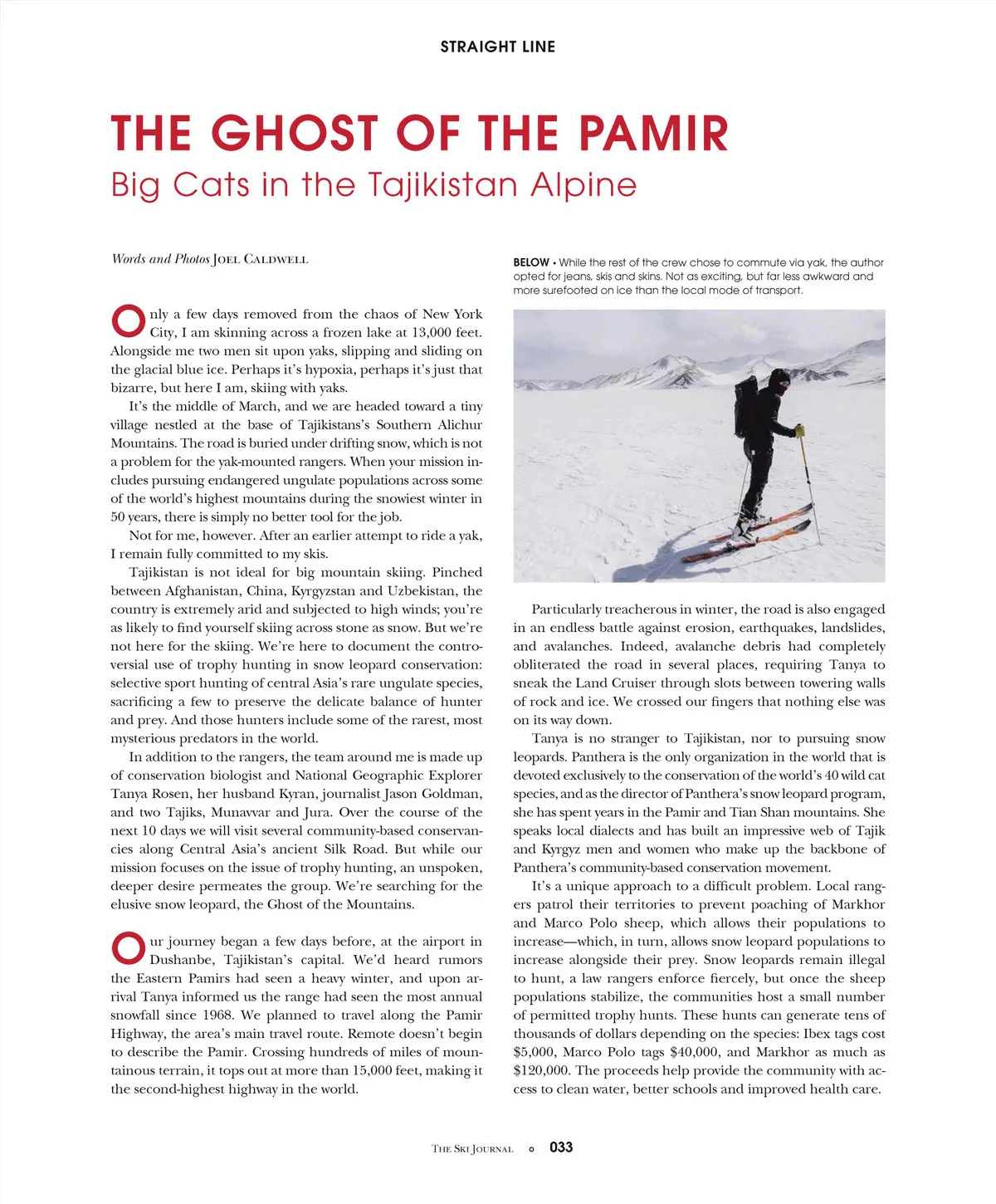
STRAIGHT LINE THE GHOST OF THE PAMIR Big Cats in the Tajikistan Alpine Words and Photos Joel Caldwell BELOW • While the rest of the crew chose to commute via yak, the author opted for jeans, skis and skins. Not as exciting, but far less awkward and more surefooted on ice than the local mode of transport. nly a few days removed from the chaos of New York City, I am skinning across a frozen lake at 13,000 feet. Alongside me two men sit upon yaks, slipping and sliding on the glacial blue ice. Perhaps it’s hypoxia, perhaps it’s just that bizarre, but here I am, skiing with yaks. It’s the middle of March, and we are headed toward a tiny village nestled at the base of Tajikistans’s Southern Alichur Mountains. The road is buried under drifting snow, which is not a problem for the yak-mounted rangers. When your mission in-cludes pursuing endangered ungulate populations across some of the world’s highest mountains during the snowiest winter in 50 years, there is simply no better tool for the job. Not for me, however. After an earlier attempt to ride a yak, I remain fully committed to my skis. Tajikistan is not ideal for big mountain skiing. Pinched between Afghanistan, China, Kyrgyzstan and Uzbekistan, the country is extremely arid and subjected to high winds; you’re as likely to find yourself skiing across stone as snow. But we’re not here for the skiing. We’re here to document the contro-versial use of trophy hunting in snow leopard conservation: selective sport hunting of central Asia’s rare ungulate species, sacrificing a few to preserve the delicate balance of hunter and prey. And those hunters include some of the rarest, most mysterious predators in the world. In addition to the rangers, the team around me is made up of conservation biologist and National Geographic Explorer Tanya Rosen, her husband Kyran, journalist Jason Goldman, and two Tajiks, Munavvar and Jura. Over the course of the next 10 days we will visit several community-based conservan-cies along Central Asia’s ancient Silk Road. But while our mission focuses on the issue of trophy hunting, an unspoken, deeper desire permeates the group. We’re searching for the elusive snow leopard, the Ghost of the Mountains. ur journey began a few days before, at the airport in Dushanbe, Tajikistan’s capital. We’d heard rumors the Eastern Pamirs had seen a heavy winter, and upon ar-rival Tanya informed us the range had seen the most annual snowfall since 1968. We planned to travel along the Pamir Highway, the area’s main travel route. Remote doesn’t begin to describe the Pamir. Crossing hundreds of miles of moun-tainous terrain, it tops out at more than 15,000 feet, making it the second-highest highway in the world. O O Particularly treacherous in winter, the road is also engaged in an endless battle against erosion, earthquakes, landslides, and avalanches. Indeed, avalanche debris had completely obliterated the road in several places, requiring Tanya to sneak the Land Cruiser through slots between towering walls of rock and ice. We crossed our fingers that nothing else was on its way down. Tanya is no stranger to Tajikistan, nor to pursuing snow leopards. Panthera is the only organization in the world that is devoted exclusively to the conservation of the world’s 40 wild cat species, and as the director of Panthera’s snow leopard program, she has spent years in the Pamir and Tian Shan mountains. She speaks local dialects and has built an impressive web of Tajik and Kyrgyz men and women who make up the backbone of Panthera’s community-based conservation movement. It’s a unique approach to a difficult problem. Local rang-ers patrol their territories to prevent poaching of Markhor and Marco Polo sheep, which allows their populations to increase—which, in turn, allows snow leopard populations to increase alongside their prey. Snow leopards remain illegal to hunt, a law rangers enforce fiercely, but once the sheep populations stabilize, the communities host a small number of permitted trophy hunts. These hunts can generate tens of thousands of dollars depending on the species: Ibex tags cost $5,000, Marco Polo tags $40,000, and Markhor as much as $120,000. The proceeds help provide the community with ac-cess to clean water, better schools and improved health care. The Ski Journal 033
The Ski Journal Volume Eleven, Issue One: Page 33