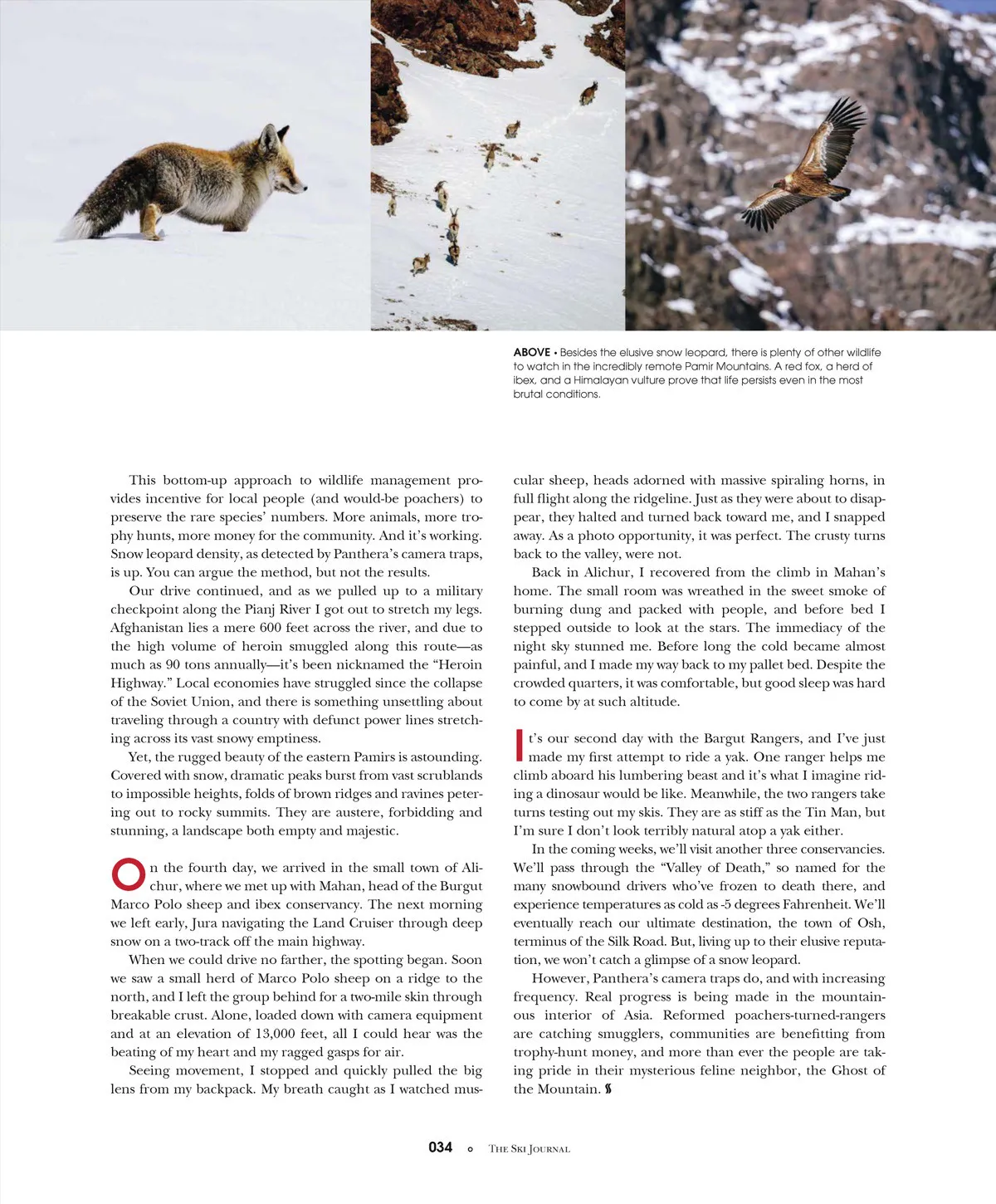
ABOVE • Besides the elusive snow leopard, there is plenty of other wildlife to watch in the incredibly remote Pamir Mountains. A red fox, a herd of ibex, and a Himalayan vulture prove that life persists even in the most brutal conditions. This bottom-up approach to wildlife management pro-vides incentive for local people (and would-be poachers) to preserve the rare species’ numbers. More animals, more tro-phy hunts, more money for the community. And it’s working. Snow leopard density, as detected by Panthera’s camera traps, is up. You can argue the method, but not the results. Our drive continued, and as we pulled up to a military checkpoint along the Pianj River I got out to stretch my legs. Afghanistan lies a mere 600 feet across the river, and due to the high volume of heroin smuggled along this route—as much as 90 tons annually—it’s been nicknamed the “Heroin Highway.” Local economies have struggled since the collapse of the Soviet Union, and there is something unsettling about traveling through a country with defunct power lines stretch-ing across its vast snowy emptiness. Yet, the rugged beauty of the eastern Pamirs is astounding. Covered with snow, dramatic peaks burst from vast scrublands to impossible heights, folds of brown ridges and ravines peter-ing out to rocky summits. They are austere, forbidding and stunning, a landscape both empty and majestic. n the fourth day, we arrived in the small town of Ali-chur, where we met up with Mahan, head of the Burgut Marco Polo sheep and ibex conservancy. The next morning we left early, Jura navigating the Land Cruiser through deep snow on a two-track off the main highway. When we could drive no farther, the spotting began. Soon we saw a small herd of Marco Polo sheep on a ridge to the north, and I left the group behind for a two-mile skin through breakable crust. Alone, loaded down with camera equipment and at an elevation of 13,000 feet, all I could hear was the beating of my heart and my ragged gasps for air. Seeing movement, I stopped and quickly pulled the big lens from my backpack. My breath caught as I watched mus-cular sheep, heads adorned with massive spiraling horns, in full flight along the ridgeline. Just as they were about to disap-pear, they halted and turned back toward me, and I snapped away. As a photo opportunity, it was perfect. The crusty turns back to the valley, were not. Back in Alichur, I recovered from the climb in Mahan’s home. The small room was wreathed in the sweet smoke of burning dung and packed with people, and before bed I stepped outside to look at the stars. The immediacy of the night sky stunned me. Before long the cold became almost painful, and I made my way back to my pallet bed. Despite the crowded quarters, it was comfortable, but good sleep was hard to come by at such altitude. t’s our second day with the Bargut Rangers, and I’ve just made my first attempt to ride a yak. One ranger helps me climb aboard his lumbering beast and it’s what I imagine rid-ing a dinosaur would be like. Meanwhile, the two rangers take turns testing out my skis. They are as stiff as the Tin Man, but I’m sure I don’t look terribly natural atop a yak either. In the coming weeks, we’ll visit another three conservancies. We’ll pass through the “Valley of Death,” so named for the many snowbound drivers who’ve frozen to death there, and experience temperatures as cold as -5 degrees Fahrenheit. We’ll eventually reach our ultimate destination, the town of Osh, terminus of the Silk Road. But, living up to their elusive reputa-a tion, we won’t catch a glimpse of a snow leopard. However, Panthera’s camera traps do, and with increasing frequency. Real progress is being made in the mountain-ous interior of Asia. Reformed poachers-turned-rangers are catching smugglers, communities are benefitting from trophy-hunt money, and more than ever the people are tak-ing pride in their mysterious feline neighbor, the Ghost of the Mountain. I O 034 The Ski Journal
The Ski Journal Volume Eleven, Issue One: Page 34