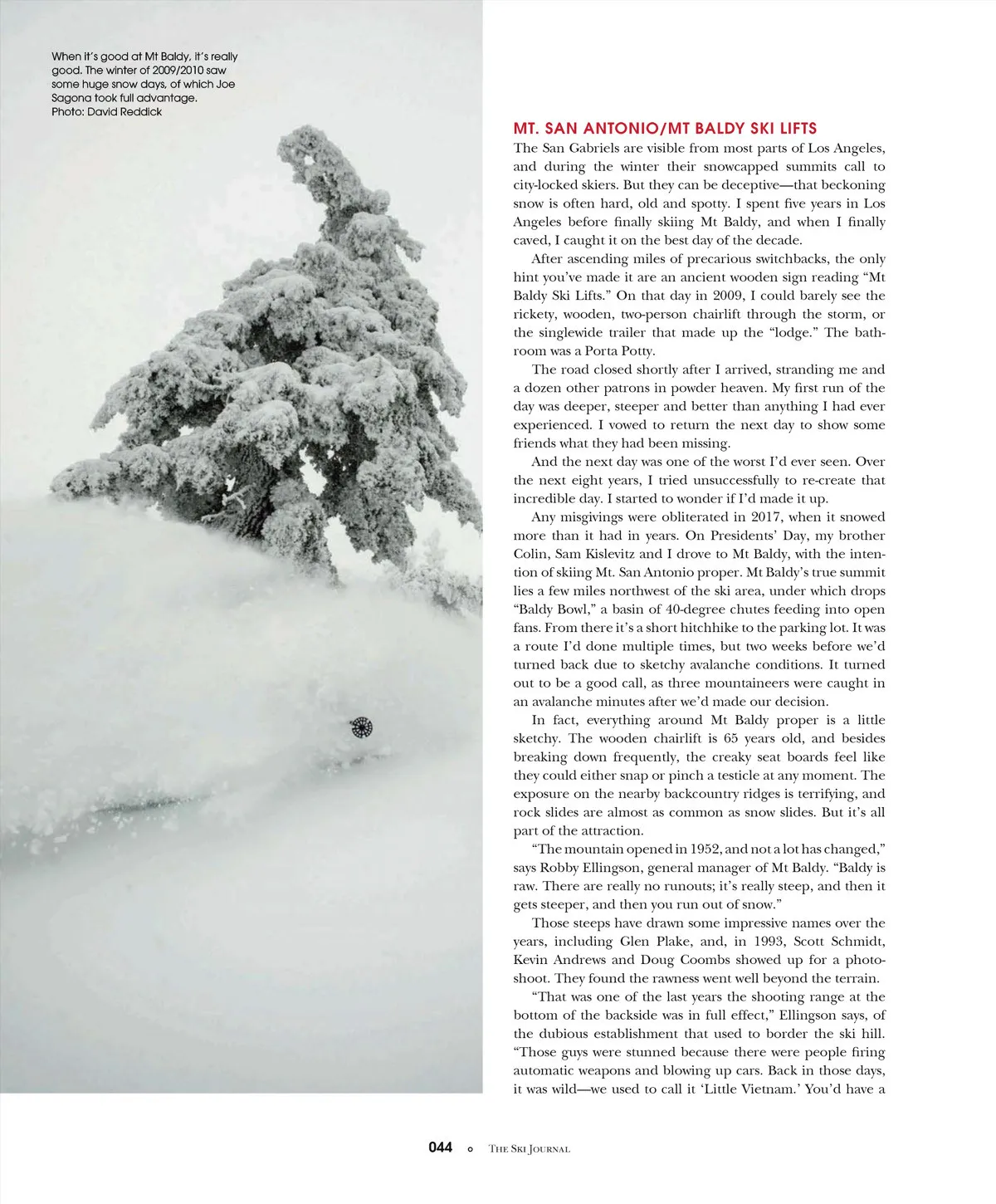
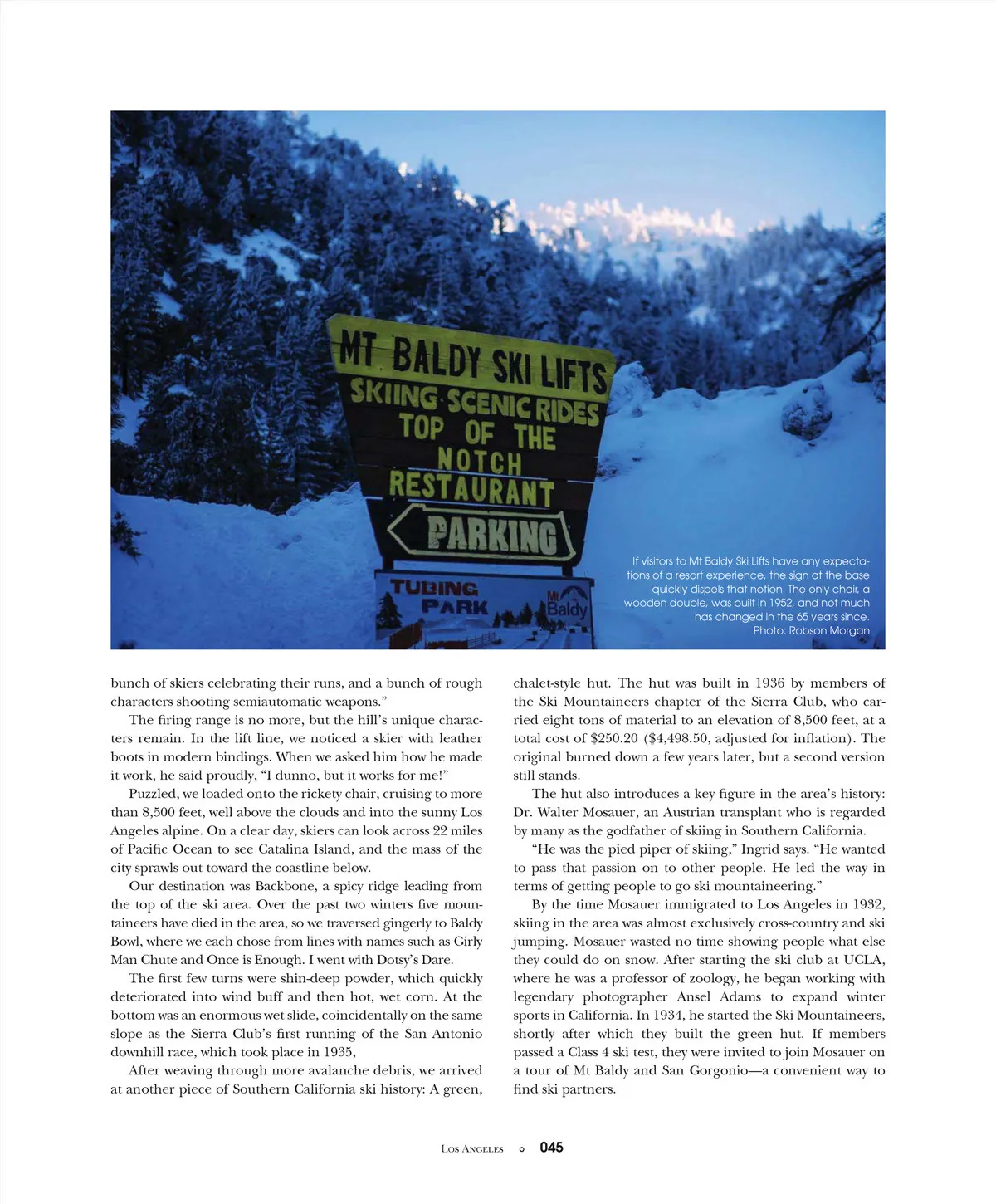
If visitors to Mt Baldy Ski Lifts have any expecta-tions of a resort experience, the sign at the base quickly dispels that notion. The only chair, a wooden double, was built in 1952, and not much has changed in the 65 years since. Photo: Robson Morgan bunch of skiers celebrating their runs, and a bunch of rough characters shooting semiautomatic weapons.” The firing range is no more, but the hill’s unique charac-ters remain. In the lift line, we noticed a skier with leather boots in modern bindings. When we asked him how he made it work, he said proudly, “I dunno, but it works for me!” Puzzled, we loaded onto the rickety chair, cruising to more than 8,500 feet, well above the clouds and into the sunny Los Angeles alpine. On a clear day, skiers can look across 22 miles of Pacific Ocean to see Catalina Island, and the mass of the city sprawls out toward the coastline below. Our destination was Backbone, a spicy ridge leading from the top of the ski area. Over the past two winters five moun-taineers have died in the area, so we traversed gingerly to Baldy Bowl, where we each chose from lines with names such as Girly Man Chute and Once is Enough. I went with Dotsy’s Dare. The first few turns were shin-deep powder, which quickly deteriorated into wind buff and then hot, wet corn. At the bottom was an enormous wet slide, coincidentally on the same slope as the Sierra Club’s first running of the San Antonio downhill race, which took place in 1935, After weaving through more avalanche debris, we arrived at another piece of Southern California ski history: A green, chalet-style hut. The hut was built in 1936 by members of the Ski Mountaineers chapter of the Sierra Club, who car-ried eight tons of material to an elevation of 8,500 feet, at a total cost of $250.20 ($4,498.50, adjusted for inflation). The original burned down a few years later, but a second version still stands. The hut also introduces a key figure in the area’s history: Dr. Walter Mosauer, an Austrian transplant who is regarded by many as the godfather of skiing in Southern California. “He was the pied piper of skiing,” Ingrid says. “He wanted to pass that passion on to other people. He led the way in terms of getting people to go ski mountaineering.” By the time Mosauer immigrated to Los Angeles in 1932, skiing in the area was almost exclusively cross-country and ski jumping. Mosauer wasted no time showing people what else they could do on snow. After starting the ski club at UCLA, where he was a professor of zoology, he began working with legendary photographer Ansel Adams to expand winter sports in California. In 1934, he started the Ski Mountaineers, shortly after which they built the green hut. If members passed a Class 4 ski test, they were invited to join Mosauer on a tour of Mt Baldy and San Gorgonio—a convenient way to find ski partners. Los Angeles 045
The Ski Journal Volume Eleven, Issue One: Page 45