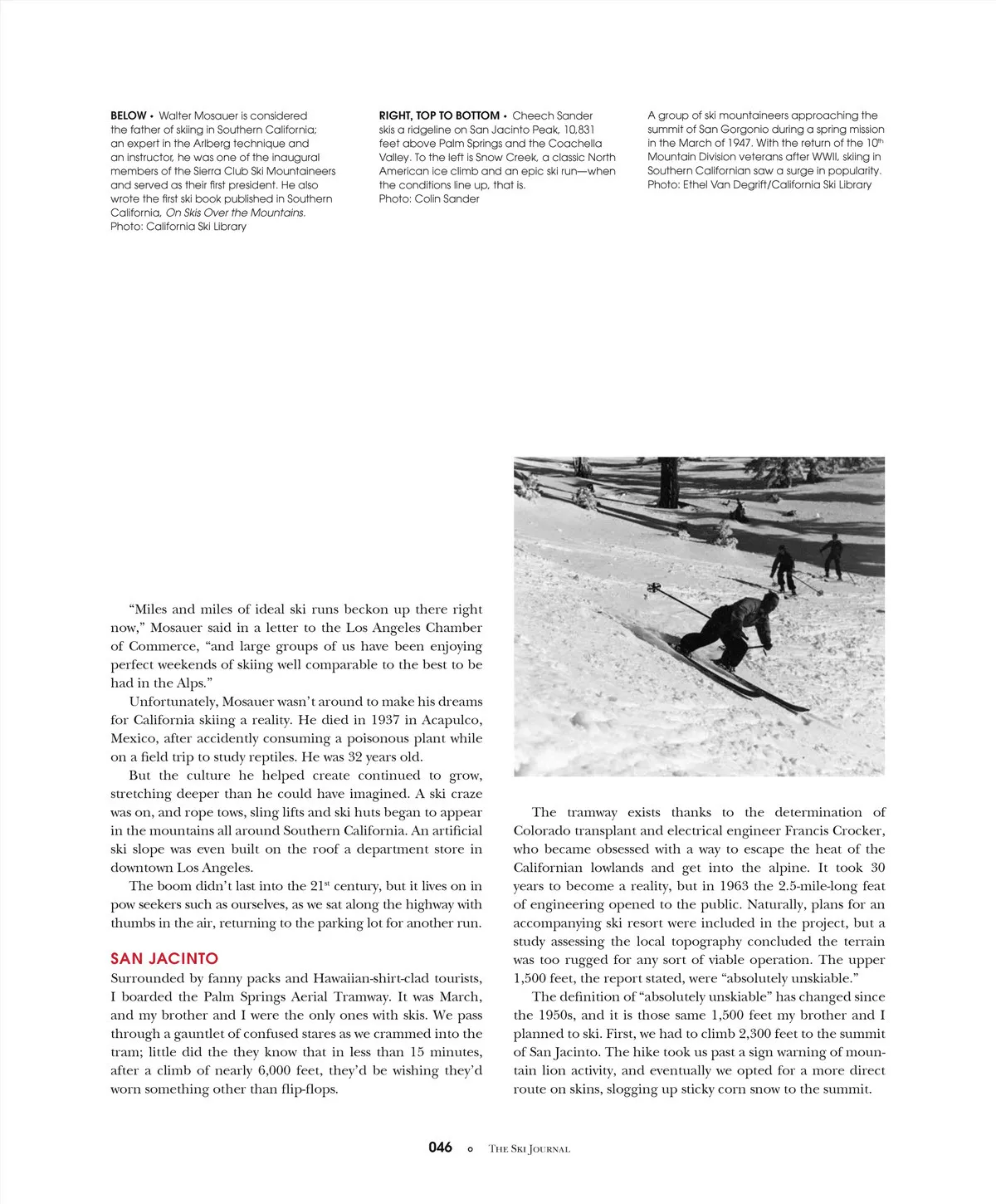
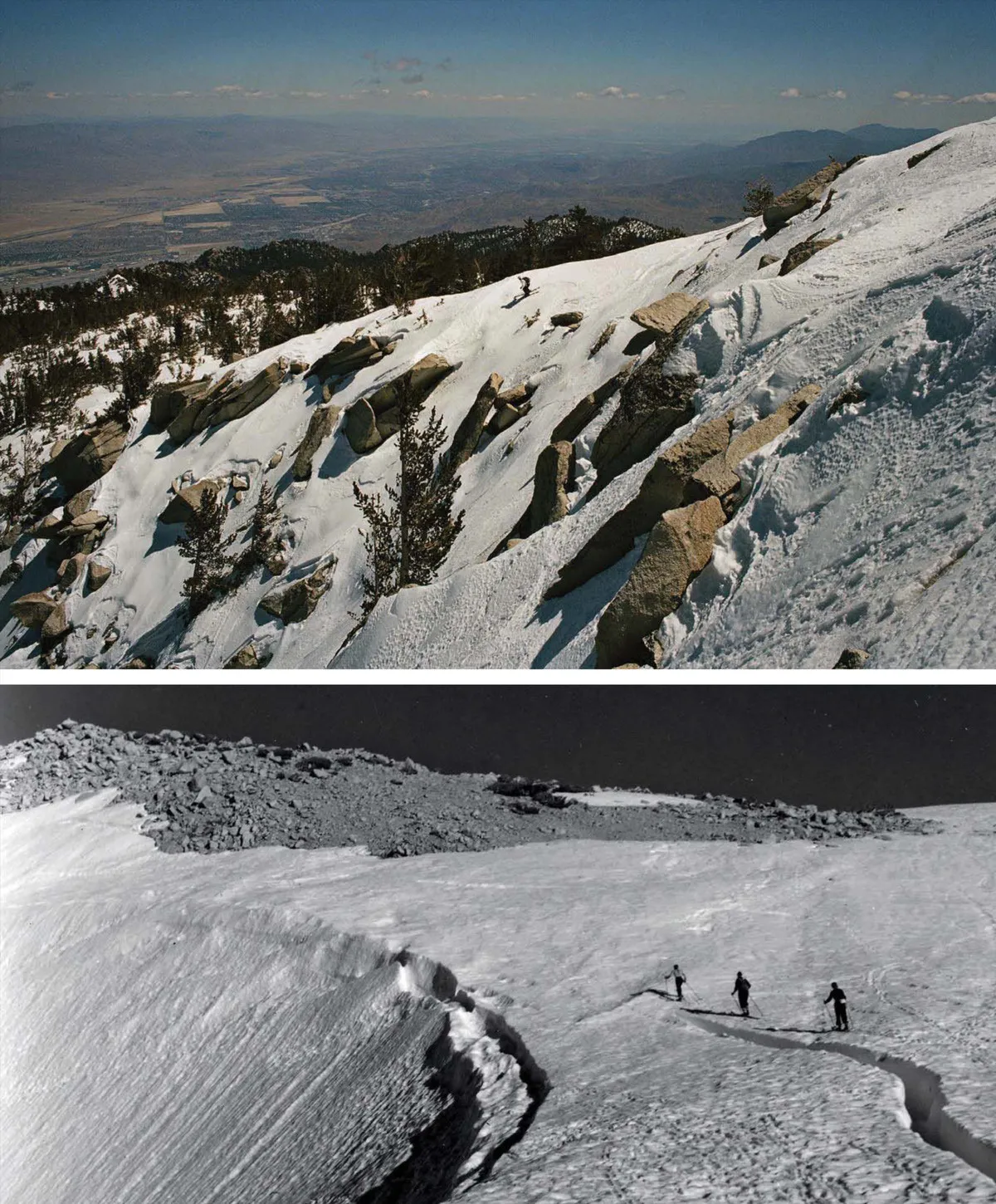
BELOW • Walter Mosauer is considered the father of skiing in Southern California; an expert in the Arlberg technique and an instructor, he was one of the inaugural members of the Sierra Club Ski Mountaineers and served as their first president. He also wrote the first ski book published in Southern California, On Skis Over the Mountains. Photo: California Ski Library RIGHT, TOP TO BOTTOM • Cheech Sander skis a ridgeline on San Jacinto Peak, 10,831 feet above Palm Springs and the Coachella Valley. To the left is Snow Creek, a classic North American ice climb and an epic ski run—when the conditions line up, that is. Photo: Colin Sander A group of ski mountaineers approaching the summit of San Gorgonio during a spring mission in the March of 1947. With the return of the 10 th Mountain Division veterans after WWII, skiing in Southern Californian saw a surge in popularity. Photo: Ethel Van Degrift/California Ski Library “Miles and miles of ideal ski runs beckon up there right now,” Mosauer said in a letter to the Los Angeles Chamber of Commerce, “and large groups of us have been enjoying perfect weekends of skiing well comparable to the best to be had in the Alps.” Unfortunately, Mosauer wasn’t around to make his dreams for California skiing a reality. He died in 1937 in Acapulco, Mexico, after accidently consuming a poisonous plant while on a field trip to study reptiles. He was 32 years old. But the culture he helped create continued to grow, stretching deeper than he could have imagined. A ski craze was on, and rope tows, sling lifts and ski huts began to appear in the mountains all around Southern California. An artificial ski slope was even built on the roof a department store in downtown Los Angeles. The boom didn’t last into the 21 st t century, but it lives on in pow seekers such as ourselves, as we sat along the highway with thumbs in the air, returning to the parking lot for another run. SAN JACINTO Surrounded by fanny packs and Hawaiian-shirt-clad tourists, I boarded the Palm Springs Aerial Tramway. It was March, and my brother and I were the only ones with skis. We pass through a gauntlet of confused stares as we crammed into the tram; little did the they know that in less than 15 minutes, after a climb of nearly 6,000 feet, they’d be wishing they’d worn something other than flip-flops. The tramway exists thanks to the determination of Colorado transplant and electrical engineer Francis Crocker, who became obsessed with a way to escape the heat of the Californian lowlands and get into the alpine. It took 30 years to become a reality, but in 1963 the 2.5-mile-long feat of engineering opened to the public. Naturally, plans for an accompanying ski resort were included in the project, but a study assessing the local topography concluded the terrain was too rugged for any sort of viable operation. The upper 1,500 feet, the report stated, were “absolutely unskiable.” The definition of “absolutely unskiable” has changed since the 1950s, and it is those same 1,500 feet my brother and I planned to ski. First, we had to climb 2,300 feet to the summit of San Jacinto. The hike took us past a sign warning of moun-tain lion activity, and eventually we opted for a more direct route on skins, slogging up sticky corn snow to the summit. 046 The Ski Journal
The Ski Journal Volume Eleven, Issue One: Page 46