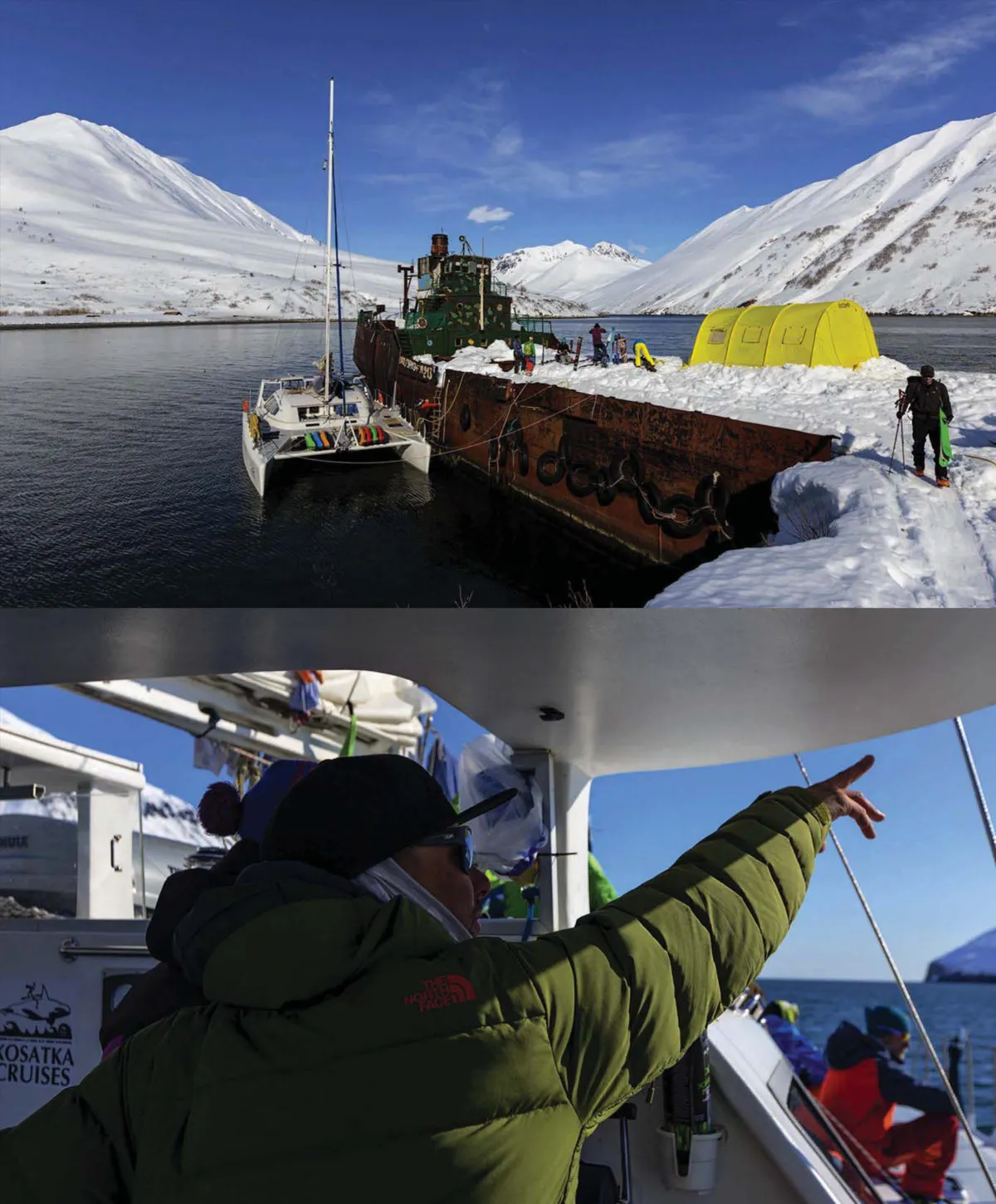
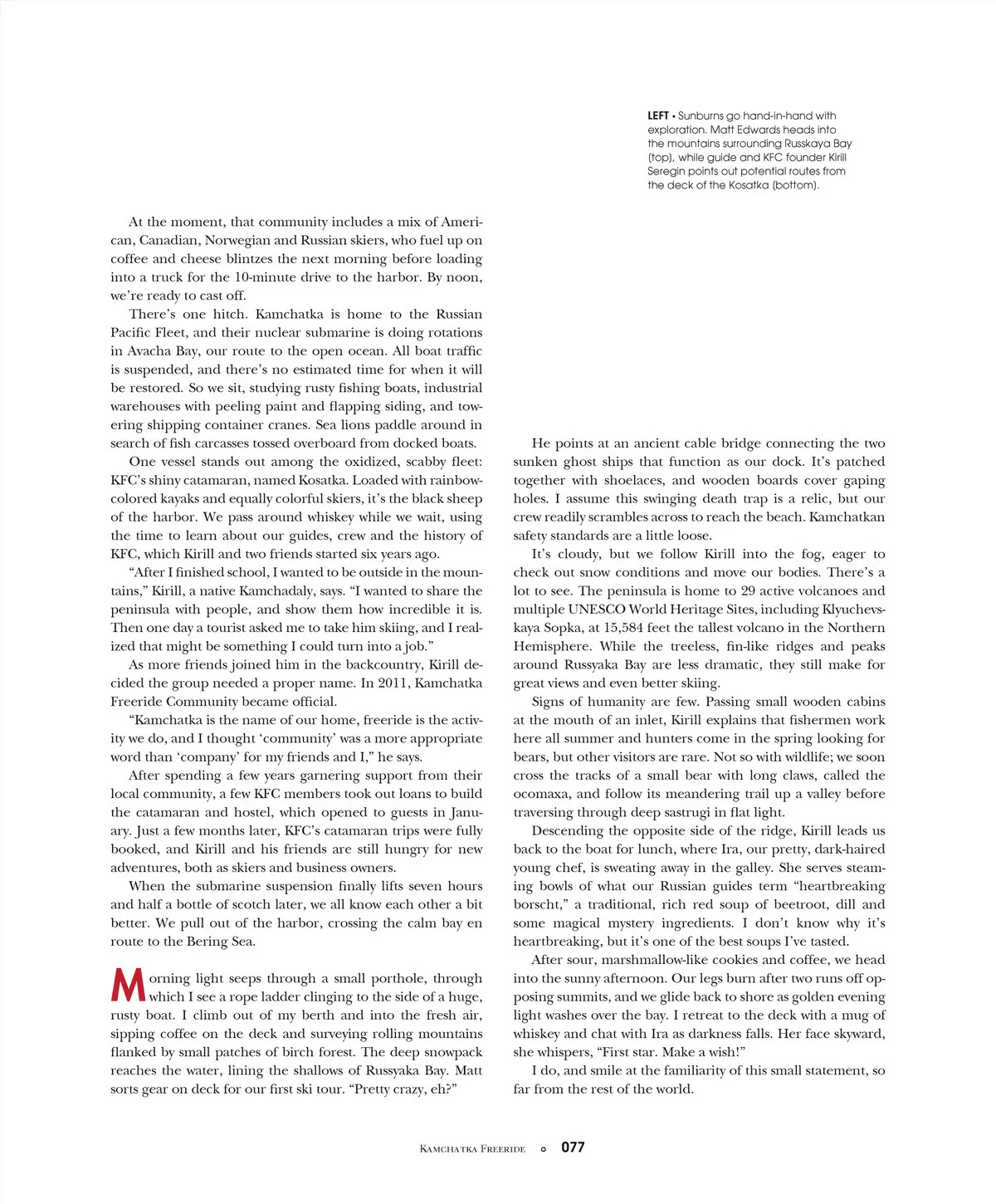
LEFT • Sunburns go hand-in-hand with exploration. Matt Edwards heads into the mountains surrounding Russkaya Bay [top], while guide and KFC founder Kirill Seregin points out potential routes from the deck of the Kosatka [bottom]. At the moment, that community includes a mix of Ameri-can, Canadian, Norwegian and Russian skiers, who fuel up on coffee and cheese blintzes the next morning before loading into a truck for the 10-minute drive to the harbor. By noon, we’re ready to cast off. There’s one hitch. Kamchatka is home to the Russian Pacific Fleet, and their nuclear submarine is doing rotations in Avacha Bay, our route to the open ocean. All boat traffic is suspended, and there’s no estimated time for when it will be restored. So we sit, studying rusty fishing boats, industrial warehouses with peeling paint and flapping siding, and tow-w ering shipping container cranes. Sea lions paddle around in search of fish carcasses tossed overboard from docked boats. One vessel stands out among the oxidized, scabby fleet: KFC’s shiny catamaran, named Kosatka. Loaded with rainbow-colored kayaks and equally colorful skiers, it’s the black sheep of the harbor. We pass around whiskey while we wait, using the time to learn about our guides, crew and the history of KFC, which Kirill and two friends started six years ago. “After I finished school, I wanted to be outside in the moun-tains,” Kirill, a native Kamchadaly, says. “I wanted to share the peninsula with people, and show them how incredible it is. Then one day a tourist asked me to take him skiing, and I real-ized that might be something I could turn into a job.” As more friends joined him in the backcountry, Kirill de-cided the group needed a proper name. In 2011, Kamchatka Freeride Community became official. “Kamchatka is the name of our home, freeride is the activ-v ity we do, and I thought ‘community’ was a more appropriate word than ‘company’ for my friends and I,” he says. After spending a few years garnering support from their local community, a few KFC members took out loans to build the catamaran and hostel, which opened to guests in Janu-ary. Just a few months later, KFC’s catamaran trips were fully booked, and Kirill and his friends are still hungry for new adventures, both as skiers and business owners. When the submarine suspension finally lifts seven hours and half a bottle of scotch later, we all know each other a bit better. We pull out of the harbor, crossing the calm bay en route to the Bering Sea. orning light seeps through a small porthole, through which I see a rope ladder clinging to the side of a huge, rusty boat. I climb out of my berth and into the fresh air, sipping coffee on the deck and surveying rolling mountains flanked by small patches of birch forest. The deep snowpack reaches the water, lining the shallows of Russyaka Bay. Matt sorts gear on deck for our first ski tour. “Pretty crazy, eh?” M He points at an ancient cable bridge connecting the two sunken ghost ships that function as our dock. It’s patched together with shoelaces, and wooden boards cover gaping holes. I assume this swinging death trap is a relic, but our crew readily scrambles across to reach the beach. Kamchatkan safety standards are a little loose. It’s cloudy, but we follow Kirill into the fog, eager to check out snow conditions and move our bodies. There’s a lot to see. The peninsula is home to 29 active volcanoes and multiple UNESCO World Heritage Sites, including Klyuchevs-kaya Sopka, at 15,584 feet the tallest volcano in the Northern Hemisphere. While the treeless, fin-like ridges and peaks around Russyaka Bay are less dramatic, they still make for great views and even better skiing. Signs of humanity are few. Passing small wooden cabins at the mouth of an inlet, Kirill explains that fishermen work here all summer and hunters come in the spring looking for bears, but other visitors are rare. Not so with wildlife; we soon cross the tracks of a small bear with long claws, called the ocomaxa, and follow its meandering trail up a valley before traversing through deep sastrugi in flat light. Descending the opposite side of the ridge, Kirill leads us back to the boat for lunch, where Ira, our pretty, dark-haired young chef, is sweating away in the galley. She serves steam-ing bowls of what our Russian guides term “heartbreaking borscht,” a traditional, rich red soup of beetroot, dill and some magical mystery ingredients. I don’t know why it’s heartbreaking, but it’s one of the best soups I’ve tasted. After sour, marshmallow-like cookies and coffee, we head into the sunny afternoon. Our legs burn after two runs off op-posing summits, and we glide back to shore as golden evening light washes over the bay. I retreat to the deck with a mug of whiskey and chat with Ira as darkness falls. Her face skyward, she whispers, “First star. Make a wish!” I do, and smile at the familiarity of this small statement, so far from the rest of the world. Kamchatka Freeride 077
The Ski Journal Volume Eleven, Issue One: Page 77