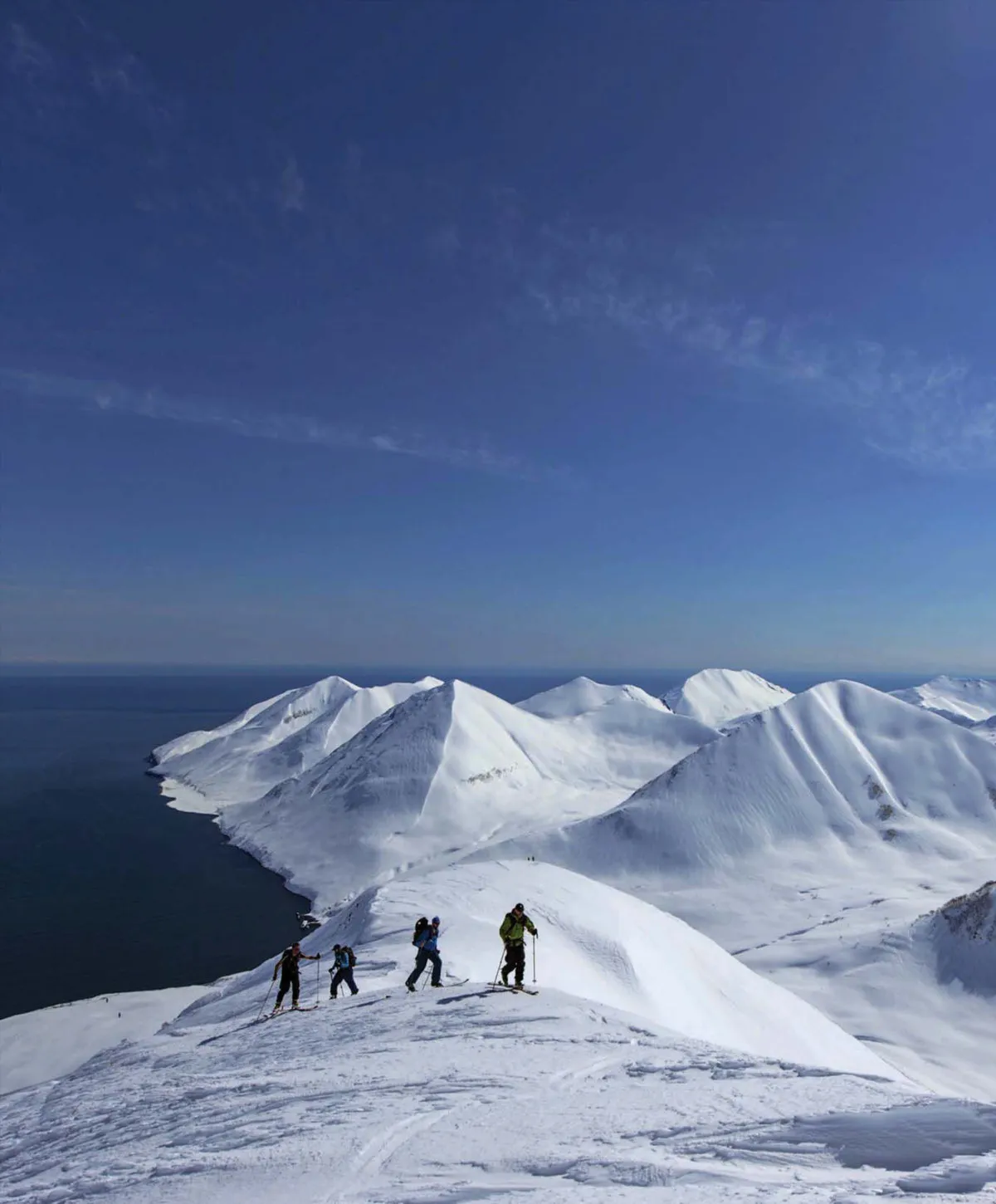
RIGHT • With an entire population of less than 350,000 people spread out over 100,000 square miles, the Kamchatka Peninsula is not a crowded place. That leaves plenty of virgin terrain and empty horizons. The crew summits another un-named peak, high above the Bering Sea. he next day dawns bright and clear, and Nikita Pecherskiy, a ski guide from Moscow pursuing his RMGA certification, sets the track up a prominent mountain at the head of the bay. Its long, undulating summit ridge is coated in rime. In the distance, volcanoes shoot skyward, towering 11,000 feet above sea level. Couloirs drop off both sides of our summit, but Nikita opts for a dogleg chute with a steep middle section. He styles the line in three swooping turns, picking up speed as he rips the runout. He’s an extremely solid skier, without the explosive crashes as suggested by the videos at the hostel. KFC offers more than just skiing, and after lunch Kirill leads us across the swinging bridge to a pebble beach where the kayaks are staged. There’s one rule: No tipping over. Hu-mans can’t survive long in 40-degree water. We paddle across the bay to a cascading waterfall and then out to sea, past 100-foot-tall cliffs with waves curling and breaking against the shore. Matt searches out potential surf breaks while I scope lines for tomorrow. It’s a long paddle back, and I’m happy to see that Kirill and his team have a driftwood fire blazing for a relaxed beachside evening. We sip mulled wine heated on the coals, and I learn the Russians visiting from Moscow and St. Petersburg are as entranced by Kamchatka as many of my friends back home. “For Russians, Kamchatka is as far a place as for Ameri-cans,” Evgeny explains. “There are a lot of myths—that there are bears and volcanoes in the center of the city, that locals eat caviar every day, and that it is very expensive. But every Russian freerider dreams of dropping from the top of a vol-cano in Kamchatka. “No one can for real explain to you what is Kamchatka. You should understand it only yourself and only here.” T n the morning, Captain Nikolay powers up the Zodiac raft and shuttles us to a different valley. It’s still in shadows and most of us don ski crampons. Not Kirill, however, who is determined to test his edges on the firm morning snow. He makes it nearly to the pass before slipping and scraping down 300 feet to a small plateau. Meeting us back on the ridge, he pulls his sleeves up to show off raspberried forearms and a chagrined look. “Crampons next time,” he says. Continuing up to the crest, just one ridge separates us from the open ocean. After agreeing that we’re up for a long walk back, we do a few more runs and ski as close to the shore as we can. Atop the next peak, we listen to the sounds of sea lions barking in the wind, their raucous calls carried up from the bay far below. “I think we are the first people here,” Kirill says, casually. “No one comes here except fishermen or hunters. They have no reason to climb this mountain. And I have never been here. So we are the first.” Kirill carves toward the Bering Sea, stopping at a hunter’s cabin on the shore of a frozen lake. With so much untouched terrain to explore, it’s nearly as overwhelming as it is peaceful. “We created this project because we love our land and believe in its potential,” Kirill says, as we begin the climb up for another run on another unnamed peak. “This is just the beginning.” I 078 The Ski Journal
The Ski Journal Volume Eleven, Issue One: Page 78