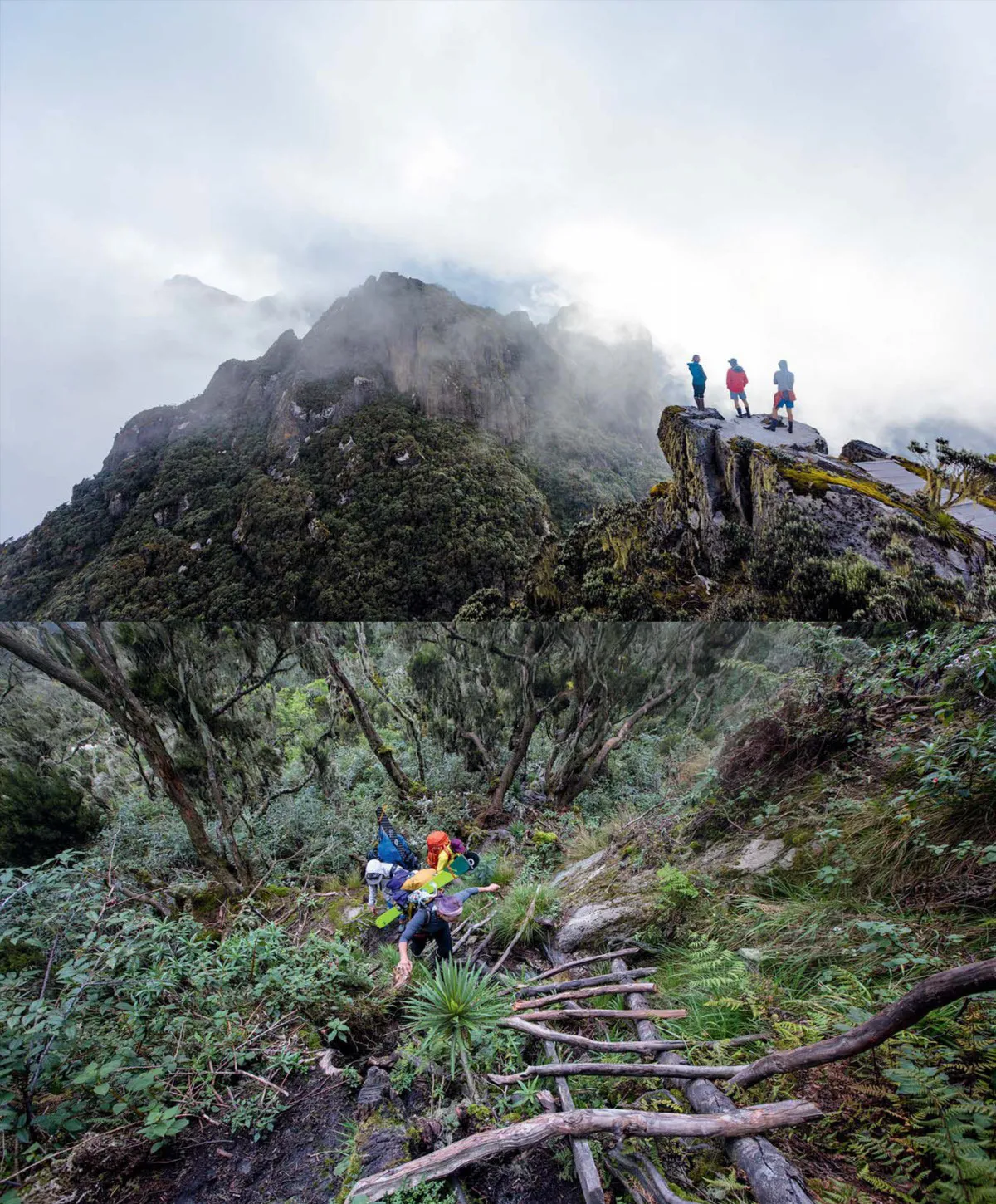
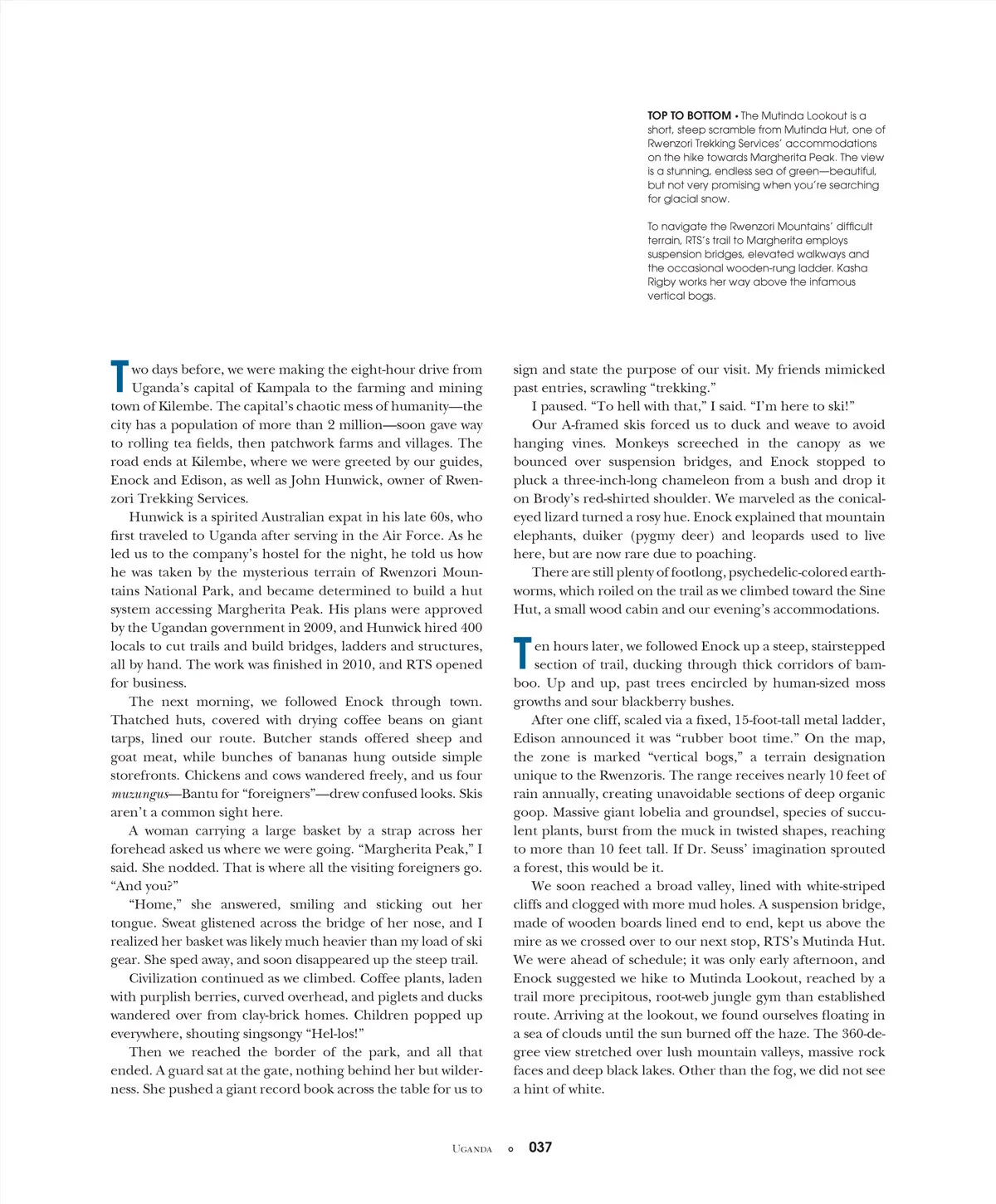
TOP TO BOTTOM • The Mutinda Lookout is a short, steep scramble from Mutinda Hut, one of Rwenzori Trekking Services’ accommodations on the hike towards Margherita Peak. The view is a stunning, endless sea of green—beautiful, but not very promising when you’re searching for glacial snow. To navigate the Rwenzori Mountains’ difficult terrain, RTS’s trail to Margherita employs suspension bridges, elevated walkways and the occasional wooden-rung ladder. Kasha Rigby works her way above the infamous vertical bogs. T wo days before, we were making the eight-hour drive from Uganda’s capital of Kampala to the farming and mining town of Kilembe. The capital’s chaotic mess of humanity—the city has a population of more than 2 million—soon gave way to rolling tea fields, then patchwork farms and villages. The road ends at Kilembe, where we were greeted by our guides, Enock and Edison, as well as John Hunwick, owner of Rwen-zori Trekking Services. Hunwick is a spirited Australian expat in his late 60s, who first traveled to Uganda after serving in the Air Force. As he led us to the company’s hostel for the night, he told us how he was taken by the mysterious terrain of Rwenzori Moun-tains National Park, and became determined to build a hut system accessing Margherita Peak. His plans were approved by the Ugandan government in 2009, and Hunwick hired 400 locals to cut trails and build bridges, ladders and structures, all by hand. The work was finished in 2010, and RTS opened for business. The next morning, we followed Enock through town. Thatched huts, covered with drying coffee beans on giant tarps, lined our route. Butcher stands offered sheep and goat meat, while bunches of bananas hung outside simple storefronts. Chickens and cows wandered freely, and us four muzungus —Bantu for “foreigners”—drew confused looks. Skis aren’t a common sight here. A woman carrying a large basket by a strap across her forehead asked us where we were going. “Margherita Peak,” I said. She nodded. That is where all the visiting foreigners go. “And you?” “Home,” she answered, smiling and sticking out her tongue. Sweat glistened across the bridge of her nose, and I realized her basket was likely much heavier than my load of ski gear. She sped away, and soon disappeared up the steep trail. Civilization continued as we climbed. Coffee plants, laden with purplish berries, curved overhead, and piglets and ducks wandered over from clay-brick homes. Children popped up everywhere, shouting singsongy “Hel-los!” Then we reached the border of the park, and all that ended. A guard sat at the gate, nothing behind her but wilder-ness. She pushed a giant record book across the table for us to sign and state the purpose of our visit. My friends mimicked past entries, scrawling “trekking.” I paused. “To hell with that,” I said. “I’m here to ski!” Our A-framed skis forced us to duck and weave to avoid hanging vines. Monkeys screeched in the canopy as we bounced over suspension bridges, and Enock stopped to pluck a three-inch-long chameleon from a bush and drop it on Brody’s red-shirted shoulder. We marveled as the conical-eyed lizard turned a rosy hue. Enock explained that mountain elephants, duiker (pygmy deer) and leopards used to live here, but are now rare due to poaching. There are still plenty of footlong, psychedelic-colored earth-worms, which roiled on the trail as we climbed toward the Sine Hut, a small wood cabin and our evening’s accommodations. T en hours later, we followed Enock up a steep, stairstepped section of trail, ducking through thick corridors of bam-boo. Up and up, past trees encircled by human-sized moss growths and sour blackberry bushes. After one cliff, scaled via a fixed, 15-foot-tall metal ladder, Edison announced it was “rubber boot time.” On the map, the zone is marked “vertical bogs,” a terrain designation unique to the Rwenzoris. The range receives nearly 10 feet of rain annually, creating unavoidable sections of deep organic goop. Massive giant lobelia and groundsel, species of succu-lent plants, burst from the muck in twisted shapes, reaching to more than 10 feet tall. If Dr. Seuss’ imagination sprouted a forest, this would be it. We soon reached a broad valley, lined with white-striped cliffs and clogged with more mud holes. A suspension bridge, made of wooden boards lined end to end, kept us above the mire as we crossed over to our next stop, RTS’s Mutinda Hut. We were ahead of schedule; it was only early afternoon, and Enock suggested we hike to Mutinda Lookout, reached by a trail more precipitous, root-web jungle gym than established route. Arriving at the lookout, we found ourselves floating in a sea of clouds until the sun burned off the haze. The 360-de-gree view stretched over lush mountain valleys, massive rock faces and deep black lakes. Other than the fog, we did not see a hint of white. Uganda 037
The Ski Journal Volume Eleven, Issue Three: Page 37