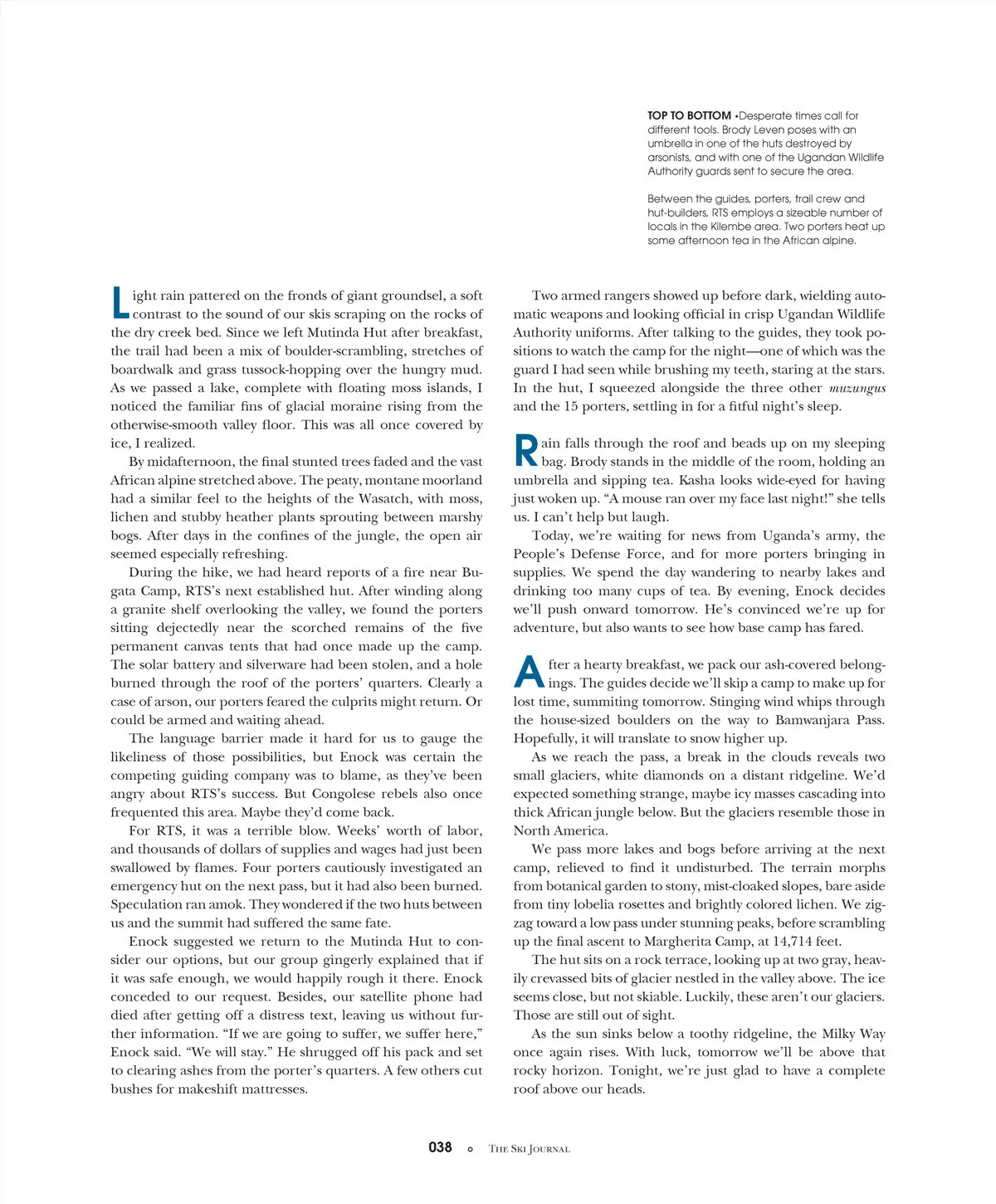
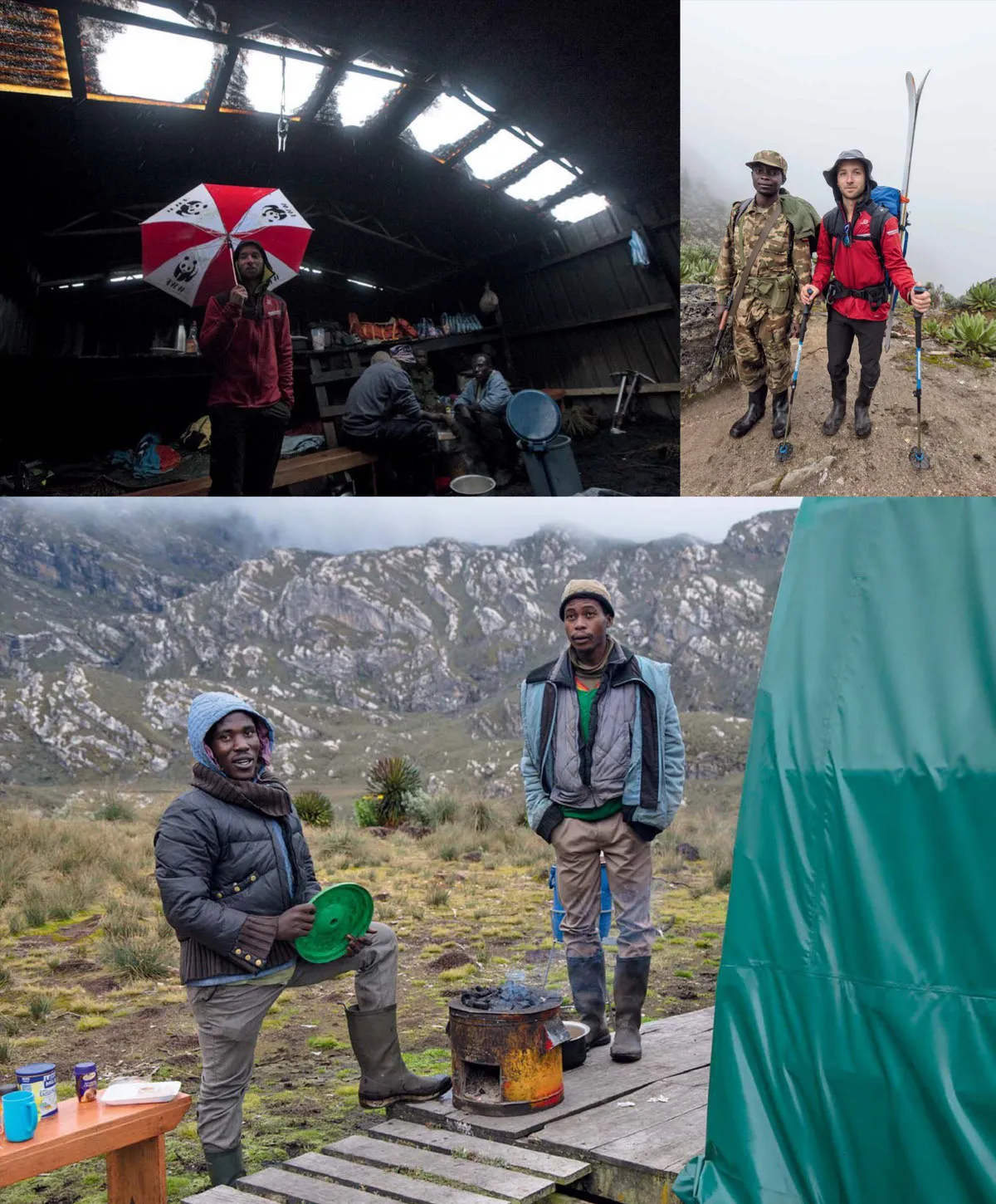
TOP TO BOTTOM • Desperate times call for different tools. Brody Leven poses with an umbrella in one of the huts destroyed by arsonists, and with one of the Ugandan Wildlife Authority guards sent to secure the area. Between the guides, porters, trail crew and hut-builders, RTS employs a sizeable number of locals in the Kilembe area. Two porters heat up some afternoon tea in the African alpine. L ight rain pattered on the fronds of giant groundsel, a soft contrast to the sound of our skis scraping on the rocks of the dry creek bed. Since we left Mutinda Hut after breakfast, the trail had been a mix of boulder-scrambling, stretches of boardwalk and grass tussock-hopping over the hungry mud. As we passed a lake, complete with floating moss islands, I noticed the familiar fins of glacial moraine rising from the otherwise-smooth valley floor. This was all once covered by ice, I realized. By midafternoon, the final stunted trees faded and the vast African alpine stretched above. The peaty, montane moorland had a similar feel to the heights of the Wasatch, with moss, lichen and stubby heather plants sprouting between marshy bogs. After days in the confines of the jungle, the open air seemed especially refreshing. During the hike, we had heard reports of a fire near Bu-gata Camp, RTS’s next established hut. After winding along a granite shelf overlooking the valley, we found the porters sitting dejectedly near the scorched remains of the five permanent canvas tents that had once made up the camp. The solar battery and silverware had been stolen, and a hole burned through the roof of the porters’ quarters. Clearly a case of arson, our porters feared the culprits might return. Or could be armed and waiting ahead. The language barrier made it hard for us to gauge the likeliness of those possibilities, but Enock was certain the competing guiding company was to blame, as they’ve been angry about RTS’s success. But Congolese rebels also once frequented this area. Maybe they’d come back. For RTS, it was a terrible blow. Weeks’ worth of labor, and thousands of dollars of supplies and wages had just been swallowed by flames. Four porters cautiously investigated an emergency hut on the next pass, but it had also been burned. Speculation ran amok. They wondered if the two huts between us and the summit had suffered the same fate. Enock suggested we return to the Mutinda Hut to con-sider our options, but our group gingerly explained that if it was safe enough, we would happily rough it there. Enock conceded to our request. Besides, our satellite phone had died after getting off a distress text, leaving us without fur-ther information. “If we are going to suffer, we suffer here,” Enock said. “We will stay.” He shrugged off his pack and set to clearing ashes from the porter’s quarters. A few others cut bushes for makeshift mattresses. Two armed rangers showed up before dark, wielding auto-matic weapons and looking official in crisp Ugandan Wildlife Authority uniforms. After talking to the guides, they took po-sitions to watch the camp for the night—one of which was the guard I had seen while brushing my teeth, staring at the stars. In the hut, I squeezed alongside the three other muzungus and the 15 porters, settling in for a fitful night’s sleep. ain falls through the roof and beads up on my sleeping bag. Brody stands in the middle of the room, holding an umbrella and sipping tea. Kasha looks wide-eyed for having just woken up. “A mouse ran over my face last night!” she tells us. I can’t help but laugh. Today, we’re waiting for news from Uganda’s army, the People’s Defense Force, and for more porters bringing in supplies. We spend the day wandering to nearby lakes and drinking too many cups of tea. By evening, Enock decides we’ll push onward tomorrow. He’s convinced we’re up for adventure, but also wants to see how base camp has fared. fter a hearty breakfast, we pack our ash-covered belong-ings. The guides decide we’ll skip a camp to make up for lost time, summiting tomorrow. Stinging wind whips through the house-sized boulders on the way to Bamwanjara Pass. Hopefully, it will translate to snow higher up. As we reach the pass, a break in the clouds reveals two small glaciers, white diamonds on a distant ridgeline. We’d expected something strange, maybe icy masses cascading into thick African jungle below. But the glaciers resemble those in North America. We pass more lakes and bogs before arriving at the next camp, relieved to find it undisturbed. The terrain morphs from botanical garden to stony, mist-cloaked slopes, bare aside from tiny lobelia rosettes and brightly colored lichen. We zig-zag toward a low pass under stunning peaks, before scrambling up the final ascent to Margherita Camp, at 14,714 feet. The hut sits on a rock terrace, looking up at two gray, heav-ily crevassed bits of glacier nestled in the valley above. The ice seems close, but not skiable. Luckily, these aren’t our glaciers. Those are still out of sight. As the sun sinks below a toothy ridgeline, the Milky Way once again rises. With luck, tomorrow we’ll be above that rocky horizon. Tonight, we’re just glad to have a complete roof above our heads. R A 038 The Ski Journal
The Ski Journal Volume Eleven, Issue Three: Page 38