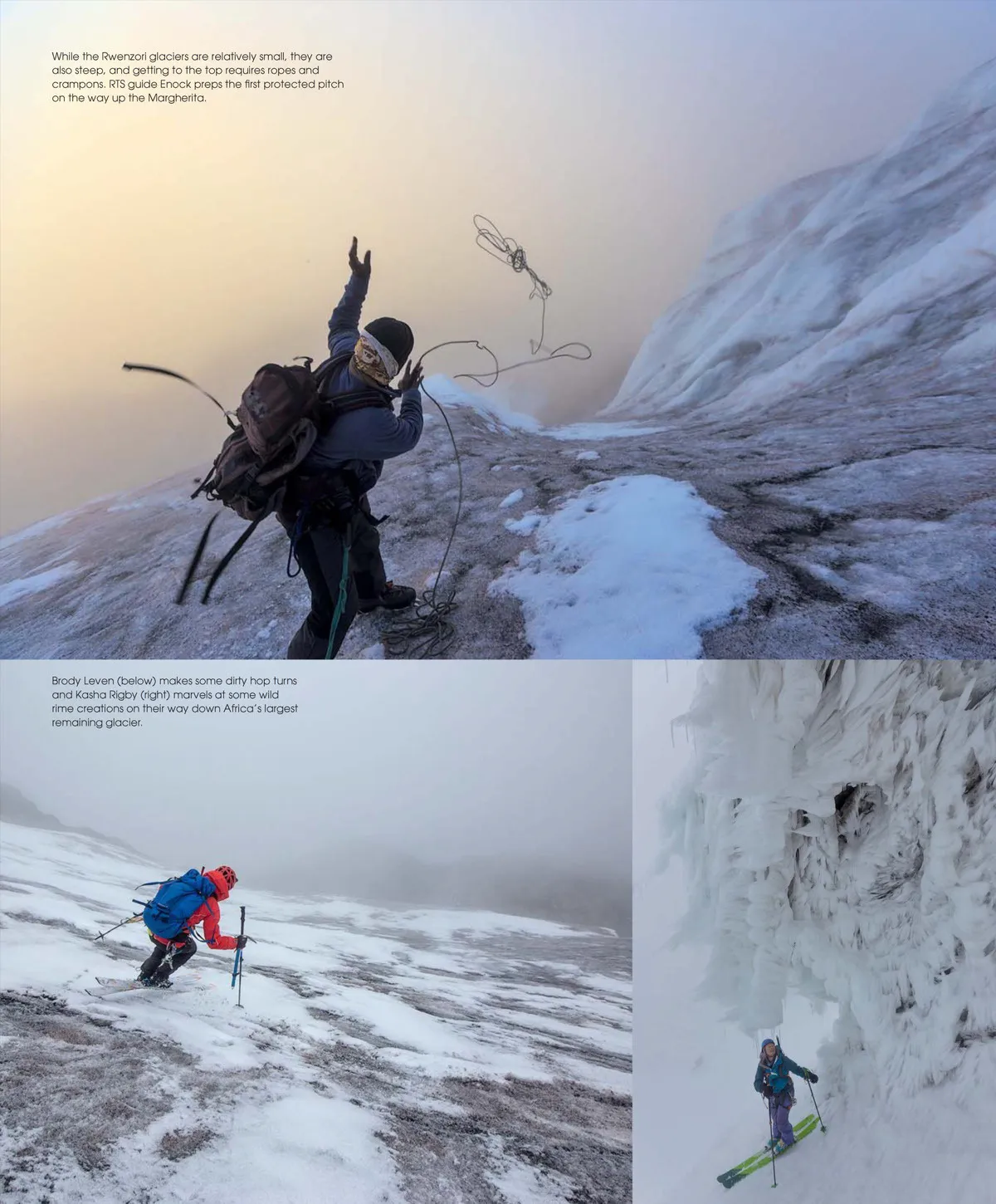
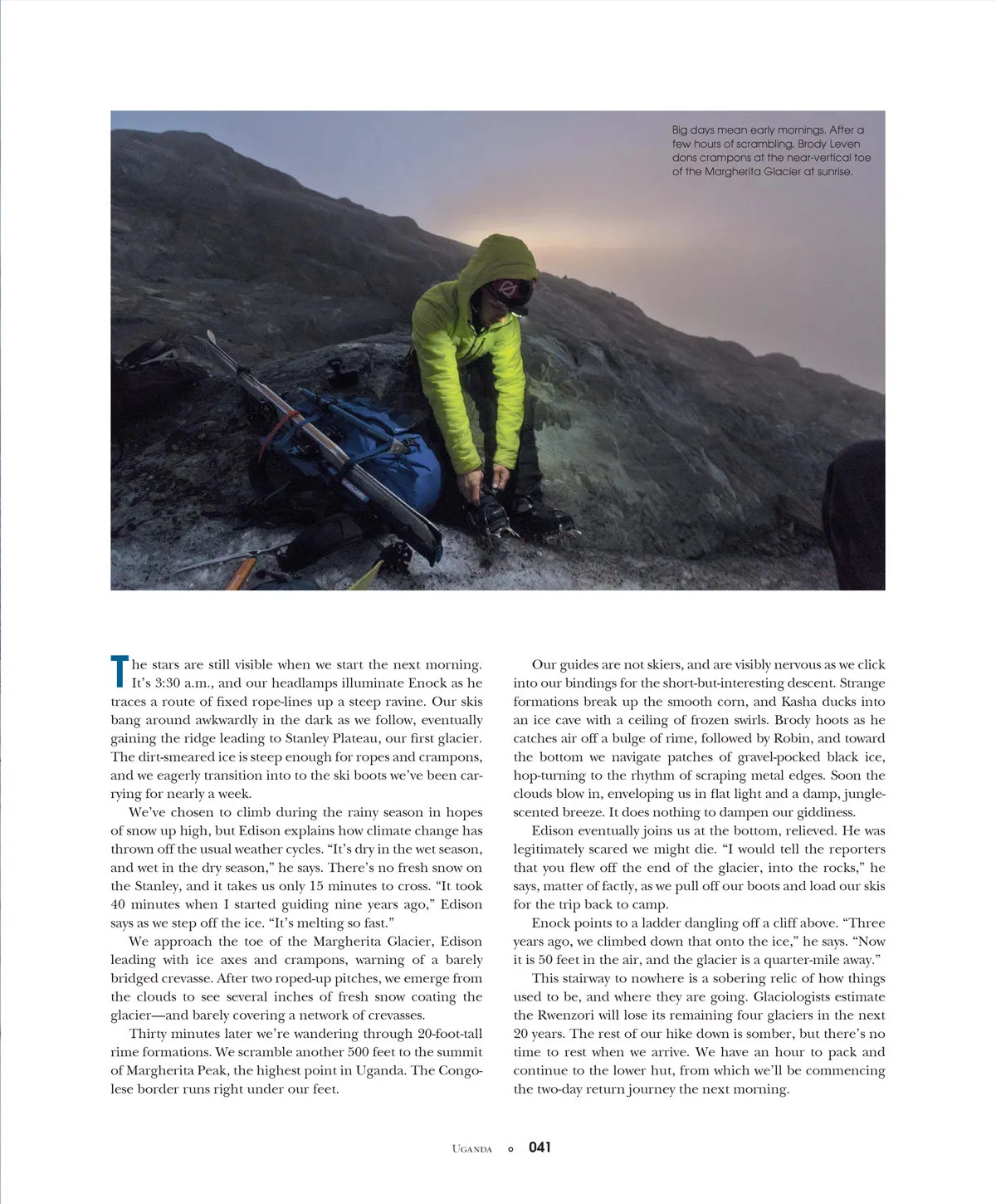
Big days mean early mornings. After a few hours of scrambling, Brody Leven dons crampons at the near-vertical toe of the Margherita Glacier at sunrise. T he stars are still visible when we start the next morning. It’s 3:30 a.m., and our headlamps illuminate Enock as he traces a route of fixed rope-lines up a steep ravine. Our skis bang around awkwardly in the dark as we follow, eventually gaining the ridge leading to Stanley Plateau, our first glacier. The dirt-smeared ice is steep enough for ropes and crampons, and we eagerly transition into to the ski boots we’ve been car-rying for nearly a week. We’ve chosen to climb during the rainy season in hopes of snow up high, but Edison explains how climate change has thrown off the usual weather cycles. “It’s dry in the wet season, and wet in the dry season,” he says. There’s no fresh snow on the Stanley, and it takes us only 15 minutes to cross. “It took 40 minutes when I started guiding nine years ago,” Edison says as we step off the ice. “It’s melting so fast.” We approach the toe of the Margherita Glacier, Edison leading with ice axes and crampons, warning of a barely bridged crevasse. After two roped-up pitches, we emerge from the clouds to see several inches of fresh snow coating the glacier—and barely covering a network of crevasses. Thirty minutes later we’re wandering through 20-foot-tall rime formations. We scramble another 500 feet to the summit of Margherita Peak, the highest point in Uganda. The Congo-lese border runs right under our feet. Our guides are not skiers, and are visibly nervous as we click into our bindings for the short-but-interesting descent. Strange formations break up the smooth corn, and Kasha ducks into an ice cave with a ceiling of frozen swirls. Brody hoots as he catches air off a bulge of rime, followed by Robin, and toward the bottom we navigate patches of gravel-pocked black ice, hop-turning to the rhythm of scraping metal edges. Soon the clouds blow in, enveloping us in flat light and a damp, jungle-scented breeze. It does nothing to dampen our giddiness. Edison eventually joins us at the bottom, relieved. He was legitimately scared we might die. “I would tell the reporters that you flew off the end of the glacier, into the rocks,” he says, matter of factly, as we pull off our boots and load our skis for the trip back to camp. Enock points to a ladder dangling off a cliff above. “Three years ago, we climbed down that onto the ice,” he says. “Now it is 50 feet in the air, and the glacier is a quarter-mile away.” This stairway to nowhere is a sobering relic of how things used to be, and where they are going. Glaciologists estimate the Rwenzori will lose its remaining four glaciers in the next 20 years. The rest of our hike down is somber, but there’s no time to rest when we arrive. We have an hour to pack and continue to the lower hut, from which we’ll be commencing the two-day return journey the next morning. Uganda 041
The Ski Journal Volume Eleven, Issue Three: Page 41