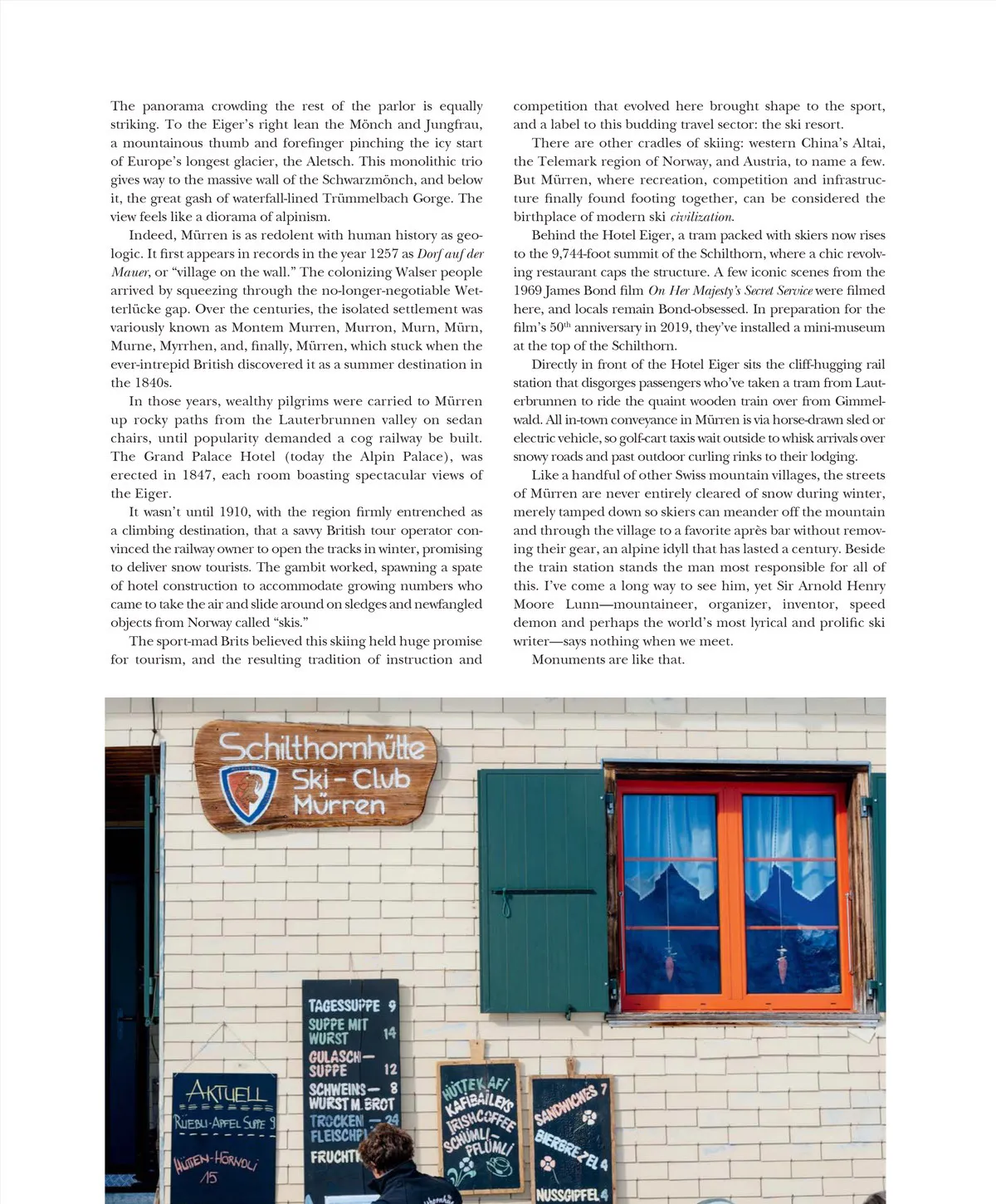
The panorama crowding the rest of the parlor is equally striking. To the Eiger’s right lean the Mönch and Jungfrau, a mountainous thumb and forefinger pinching the icy start of Europe’s longest glacier, the Aletsch. This monolithic trio gives way to the massive wall of the Schwarzmönch, and below it, the great gash of waterfall-lined Trümmelbach Gorge. The view feels like a diorama of alpinism. Indeed, Mürren is as redolent with human history as geo-logic. It first appears in records in the year 1257 as Dorf auf der Mauer , or “village on the wall.” The colonizing Walser people arrived by squeezing through the no-longer-negotiable Wet-terlücke gap. Over the centuries, the isolated settlement was variously known as Montem Murren, Murron, Murn, Mürn, Murne, Myrrhen, and, finally, Mürren, which stuck when the ever-intrepid British discovered it as a summer destination in the 1840s. In those years, wealthy pilgrims were carried to Mürren up rocky paths from the Lauterbrunnen valley on sedan chairs, until popularity demanded a cog railway be built. The Grand Palace Hotel (today the Alpin Palace), was erected in 1847, each room boasting spectacular views of the Eiger. It wasn’t until 1910, with the region firmly entrenched as a climbing destination, that a savvy British tour operator con-vinced the railway owner to open the tracks in winter, promising to deliver snow tourists. The gambit worked, spawning a spate of hotel construction to accommodate growing numbers who came to take the air and slide around on sledges and newfangled objects from Norway called “skis.” The sport-mad Brits believed this skiing held huge promise for tourism, and the resulting tradition of instruction and competition that evolved here brought shape to the sport, and a label to this budding travel sector: the ski resort. There are other cradles of skiing: western China’s Altai, the Telemark region of Norway, and Austria, to name a few. But Mürren, where recreation, competition and infrastruc-ture finally found footing together, can be considered the birthplace of modern ski civilization . Behind the Hotel Eiger, a tram packed with skiers now rises to the 9,744-foot summit of the Schilthorn, where a chic revolv-ing restaurant caps the structure. A few iconic scenes from the 1969 James Bond film On Her Majesty’s Secret Service were filmed here, and locals remain Bond-obsessed. In preparation for the film’s 50 th anniversary in 2019, they’ve installed a mini-museum at the top of the Schilthorn. Directly in front of the Hotel Eiger sits the cliff-hugging rail station that disgorges passengers who’ve taken a tram from Laut-erbrunnen to ride the quaint wooden train over from Gimmel-wald. All in-town conveyance in Mürren is via horse-drawn sled or electric vehicle, so golf-cart taxis wait outside to whisk arrivals over snowy roads and past outdoor curling rinks to their lodging. Like a handful of other Swiss mountain villages, the streets of Mürren are never entirely cleared of snow during winter, merely tamped down so skiers can meander off the mountain and through the village to a favorite après bar without remov-ing their gear, an alpine idyll that has lasted a century. Beside the train station stands the man most responsible for all of this. I’ve come a long way to see him, yet Sir Arnold Henry Moore Lunn—mountaineer, organizer, inventor, speed demon and perhaps the world’s most lyrical and prolific ski writer—says nothing when we meet. Monuments are like that.
The Ski Journal Volume Eleven, Issue Three: Page 48