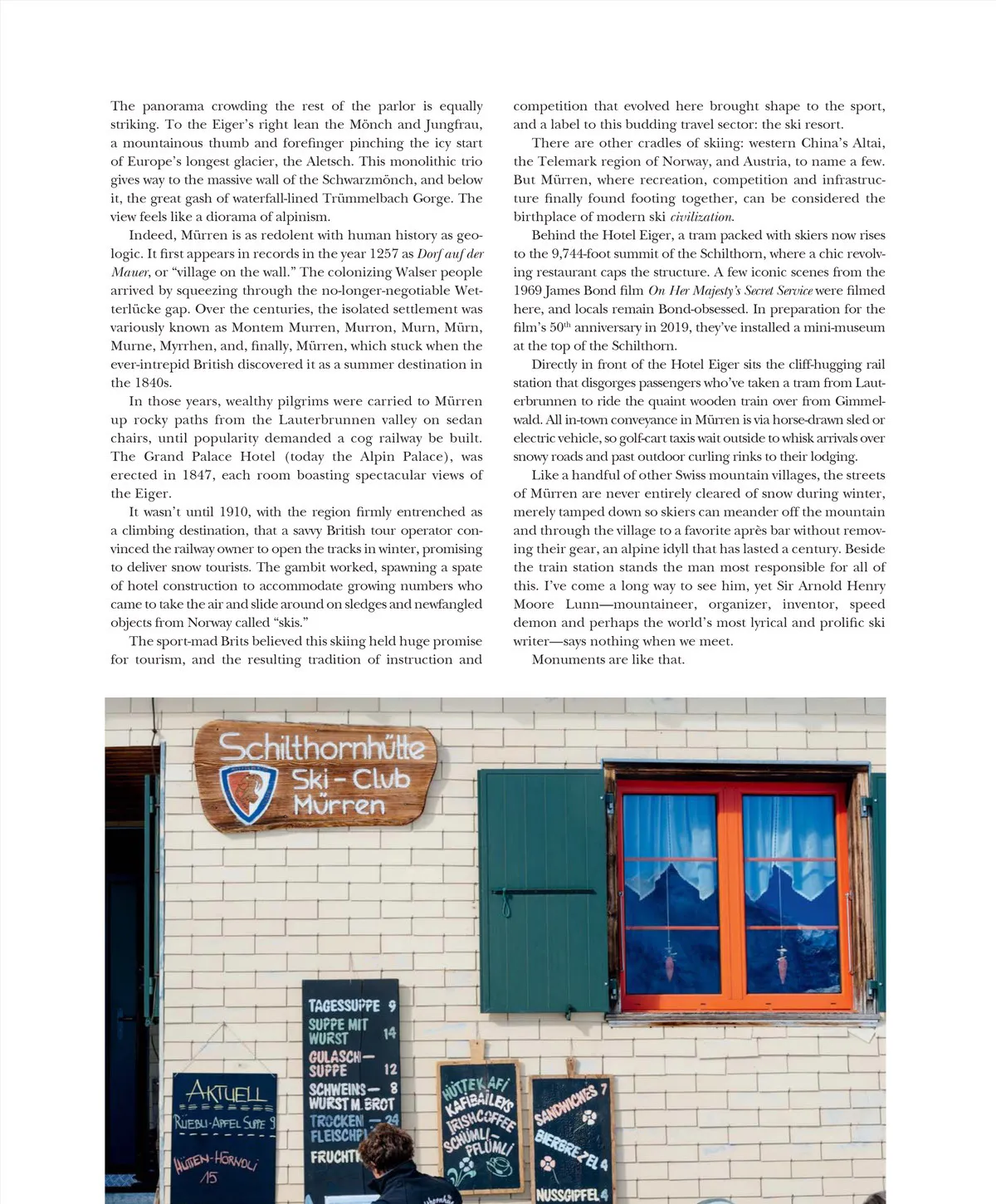
TO SKI, HOWEVER WELL OR POORLY, IS A REMINDER—WHATEVER ONE MAY FOR A LONG TIME HAVE SUSPECTED—THAT ONE IS ALIVE, AND THAT LIVING IS TREMENDOUS FUN. THERE ISN’T ANY OTHER GAME TO COMPARE WITH IT IN THE WORLD. —W. JAMES RIDDELL, AFTER WINNING THE 1929 INFERNO DOWNHILL RACE. LEFT • The Schilthornhütte, a small hut near the top of the Mürren ski resort, is owned and operated by the local ski club. It’s also one of the best places to drink a beer and watch the Inferno, the longest-running amateur ski race in the world. Photo: Mattias Fredriksson first visited the Jungfrau Region to retrace the steps of Sir Arnold and acolyte W. James Riddell, whose several books and collective works in British alpine ski journals paint them as the de facto fathers of modern ski journalism. As a ski and travel writer, I am their descendant, and had often wondered about this genealogy. The trail led me directly from the Lon-don offices of the Ski Club of Great Britain to the Bernese Oberland and eventually Mürren, where many of the pair’s writings were set. I’d long wanted to experience precisely what it was that had so inspired them. I spent my first few days skiing the rolling slopes of Grin-delwald, below the Eiger’s imposing north face, lunching at a breezy 6,760 feet in Kleine Scheidegg, Switzerland’s most storied mountain pass. Located between the Eiger and Lau-berhorn, Kleine Scheidegg boasts hotels, restaurants and a station serving two cog railways—the Wengernalpbahn, built in 1893, and the Jungfraubahn, built in 1896. While the for-mer is a straightforward route that connects Grindelwald with Lauterbrunnen and Mürren, the Jungfraubahn is a marvel of 19th-century engineering, climbing steeply through switch-back tunnels inside the Eiger and Mönch to its 11,330-foot terminus at the Jungfraujoch, Europe’s highest rail station. Along the way you can stop to gaze out windows hacked into the Eiger’s north face, over the sea of ice that is the Aletsch Glacier. This experience alone was probably enough to captivate Lunn’s and Riddell’s imaginations, and they used this conveyance for many of the high-mountain ski tours they pioneered in the region. In winter, Kleine Scheidegg becomes the pivot for both Grindelwald and Wengen ski areas, so it’s as simple as turning left or right off a chairlift to go from one to another. That made things easy when I wanted to catch the famed Lauber-horn World Cup Downhill, along with 60,000 other riotous fans. I watched the race from several places along its sinuous I course, amazed, as always, by the speed and technical skill on display, but also enjoying the ambiance of a face-painted, flag-waving, schnapps-guzzling crowd so dense it stripped the mountainside of snow. I moved to Mürren the next day to witness a stark contrast: the Inferno, the world’s oldest and largest amateur downhill race. Inaugurated by Arnold Lunn’s Kandahar Ski Club in 1928, the course drops some 8,500 vertical feet over nine miles. Early participants climbed three hours from Mürren on skis, spent the night in a hut, then climbed three more hours to the start gate the next morning. The first winner took 1 hour and 45 minutes to reach the valley; the next year, with a known route and more racers compacting the snow, a young James Riddell did it in 45 minutes. Today the fastest skier takes less than 15 minutes, and with one of 1,900 participants leaving the gate every 12 seconds, the race is a mix of pure madness and occasional carnage. It’s also an institution and tradition among Brits, who ar-rive by the hundreds to support friends or family entering the nefarious competition. Leading up to the race, Lycra suits are legion in Mürren’s streets and bars, and every ski shop has a stash of ex-World Cup downhill skis for rent. The night before the gun goes off, a crazed parade of torch bearers, creepily costumed marching bands and an enormous devil’s head snake through the extensively decorated streets. It stops at the magnificent Alpin Palace, where speeches are given, start-ing numbers drawn and livers trashed. The following night is even wilder. Being both cheerleaders and chroniclers of skiing’s early days as a competitive sport and holiday industry, I wonder whether Riddell and Lunn would have been shocked by what the Inferno—or their beloved Mürren—had become. More likely they’d be amused, and offering an “I-told-you-so” or two. Mürren 049
The Ski Journal Volume Eleven, Issue Three: Page 49