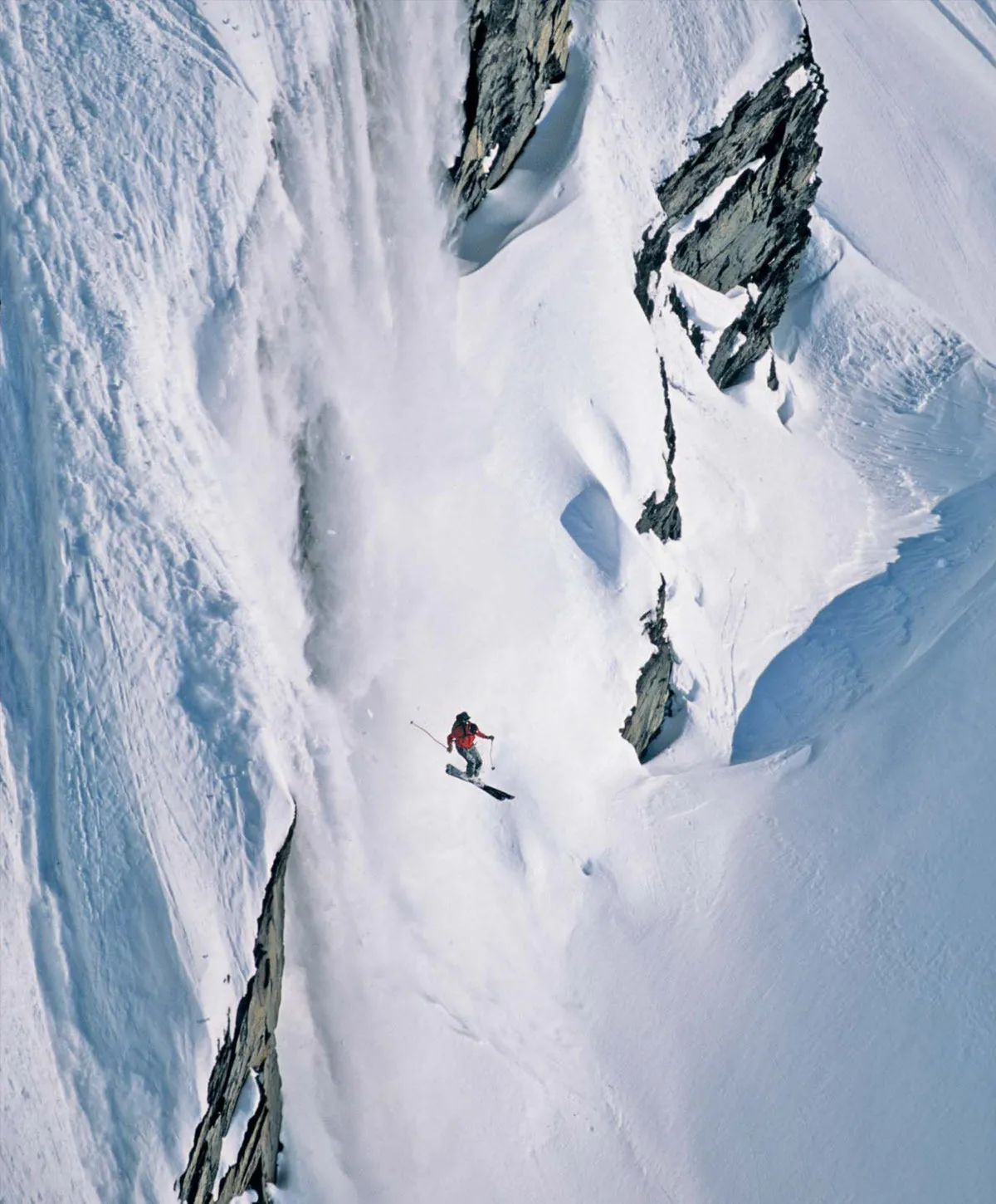
Which parking lot? ABA, the Valdez airstrip. It was a junk show—there were broken bottles everywhere and everyone was smoking weed. All the big extreme skiers and film crews would be there, so they were our clients. We’d ask, “What do you guys want to ski?” And they’d only want to pay for super-high-level stuff. Every day had a feeling of just hoping to make it back to the road alive. Doug and I were very competitive, but we were never rude to one another. We shared the same heli, so if you couldn’t get your clients together in time, one of us would take off in the helicopter, and you wouldn’t see it until it needed fuel. Let’s say someone forgot their transceiver—by the time they’d get their transceiver, I’d be walking over to the helicopter and Doug would be grinning in the front windshield waving bye-bye. Then the heli wouldn’t come back until it needed fuel at 1 p.m. He knew that if you sent the ship back for fuel, they would load my group. Then I would go to whatever place I wanted to go and he’d be stuck out there until sunset. That’s how we did it that first year with Alaska West Air. Then they upped our price in the middle of the season, and Doug and I both said, “Well, that will be the end of us working with them.” That’s when I went south. I came down toward 19 Mile, and I was more into doing the Books, and the Tusk and all that, and Doug was doing more Thompson Pass and the Cleave Glacier region. It was a pretty good setup. He and I both knew whoever was going to have the best safety record and whoever had the best protocols was going to win the permits, so we competed at protocol. We both began working with Era Helicopters. They had 90 helicopters in the state at the time because oil production was maxing out. Soon, he and I were running three to four helicopters, sometimes even five, because they had such a huge fleet. Was it still mostly industry folks or were you starting to get people showing up like, “I want to do what I saw in the movies”? The core tram riders started showing up, the guys from Jackson [Hole, WY] and Snowbird [UT]. They were becom-ing more your “real” client, so to speak, and they just wanted to ski nice, big, steep runs. We became aggressive about opening new regions, going further out there. How were the heli pilots at the time? We were scared to death flying with this original pilot named Chet Simmons. He didn’t have much protocol. You could never rely on anything; it was super inconsistent. You could be stuck out in the mountains until the sun went down— “Oh, I forgot you were out here, sorry about that.” Then we finally graduated into a Bell long-ranger [heli-copter] with this guy Jim Dale, and he was amazing. He would sail around the world in the off-season and talk about not wearing clothes for 40 days straight. He was the nicest, coolest guy ever, and we’d just guide our brains out. At the end of “This double drop is in the Tazlina Glacier region, and is really tricky. With only a pinner transition at the bottom, if you blow the first cliff you’re falling a long, long way to flat. Hit-ting it in 2008 made me feel like a terrain-park guy, aiming for the only steep-angled landing around.” —Dean Cummings Photo: John Fullbright each season, Emily [Coombs], Doug and I would go out into the mountains and ski together with Jim. The ptarmigan would be going nuts in May and the whole wilderness would be chirping and making noise. There were bears everywhere. Do any specific stories come to mind with Chet? Well, first descents were a big deal to him. He loved them as much as we did. So he put me on top of Happy Top to do the first descent. It’s one of the big ones in the range. He wouldn’t give up after 15 or 20 attempts to land. We kept getting wind sheared and almost falling off the mountain. It was super scary because he ran pontoons, which displaces the power of your aircraft—they’re also super slippery. We never had to weigh our group, you’d always max out on fuel or be above gross weight. We’d always come in at full power. So, you come in and, all of a sudden, you lose the ability to hover, to land soft enough, to land the peak, and then he’d pull off as hard as he could. You’d fall off the mountain for a thousand feet until the aircraft had enough airspeed and the blade would start flying again. He was so macho that he wouldn’t give up ever, so even if you’d be crying and begging him that you’re over it, that you don’t want the first descent, he’d keep trying to land. So finally, after the 20 th try, I got out. Then he comes buzzing over my head as I’m trying to get my skis on. He was inches above me and he’s got his 9-millimeter out the window, and he’s capping bullets. It was 6 p.m. at night and I was on my own. I skied it, then toured eight miles back to the road. He’d just drop you and you’d ski to the road? Yeah. Before you got in, he’d say, “Hi, I’m Chet Simmons. You’ve probably seen me in the movies. All you need to know about this helicopter is that if anybody makes a mistake, everybody dies but me. Got it? Get in.” And that was our briefing. It was short-lived. He finally ended up having an accident on Mt. Spur. But it was the Wild West. Sublime was playing live in the bar, the Offspring, Pennywise, the Beastie Boys. It was incredible. Skiing was dying, snowboarding was taking over. They were looking for new heroes in the sport because all there was left was [Alberto] Tomba, Plake and Schmidt. Suddenly it was like, “Wow, the average weekend warrior can relate to these guys. They’re just powder skiers.” Dean Cummings 065
The Ski Journal Volume Eleven, Issue Three: Page 65