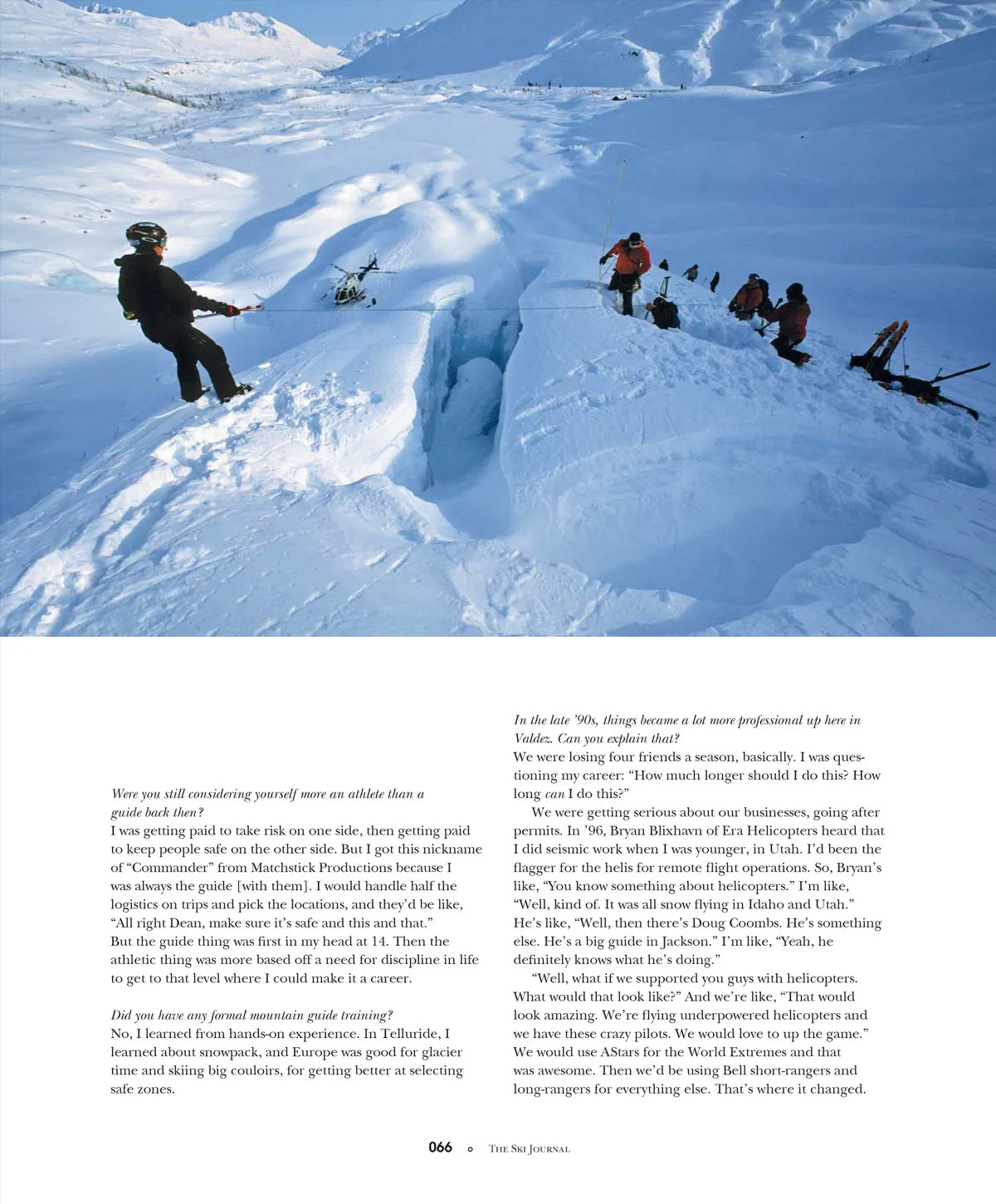
Were you still considering yourself more an athlete than a guide back then? I was getting paid to take risk on one side, then getting paid to keep people safe on the other side. But I got this nickname of “Commander” from Matchstick Productions because I was always the guide [with them]. I would handle half the logistics on trips and pick the locations, and they’d be like, “All right Dean, make sure it’s safe and this and that.” But the guide thing was first in my head at 14. Then the athletic thing was more based off a need for discipline in life to get to that level where I could make it a career. Did you have any formal mountain guide training? No, I learned from hands-on experience. In Telluride, I learned about snowpack, and Europe was good for glacier time and skiing big couloirs, for getting better at selecting safe zones. In the late ’90s, things became a lot more professional up here in Valdez. Can you explain that? We were losing four friends a season, basically. I was ques-tioning my career: “How much longer should I do this? How long can I do this?” We were getting serious about our businesses, going after permits. In ’96, Bryan Blixhavn of Era Helicopters heard that I did seismic work when I was younger, in Utah. I’d been the flagger for the helis for remote flight operations. So, Bryan’s like, “You know something about helicopters.” I’m like, “Well, kind of. It was all snow flying in Idaho and Utah.” He’s like, “Well, then there’s Doug Coombs. He’s something else. He’s a big guide in Jackson.” I’m like, “Yeah, he definitely knows what he’s doing.” “Well, what if we supported you guys with helicopters. What would that look like?” And we’re like, “That would look amazing. We’re flying underpowered helicopters and we have these crazy pilots. We would love to up the game.” We would use AStars for the World Extremes and that was awesome. Then we’d be using Bell short-rangers and long-rangers for everything else. That’s where it changed. 066 The Ski Journal
The Ski Journal Volume Eleven, Issue Three: Page 66