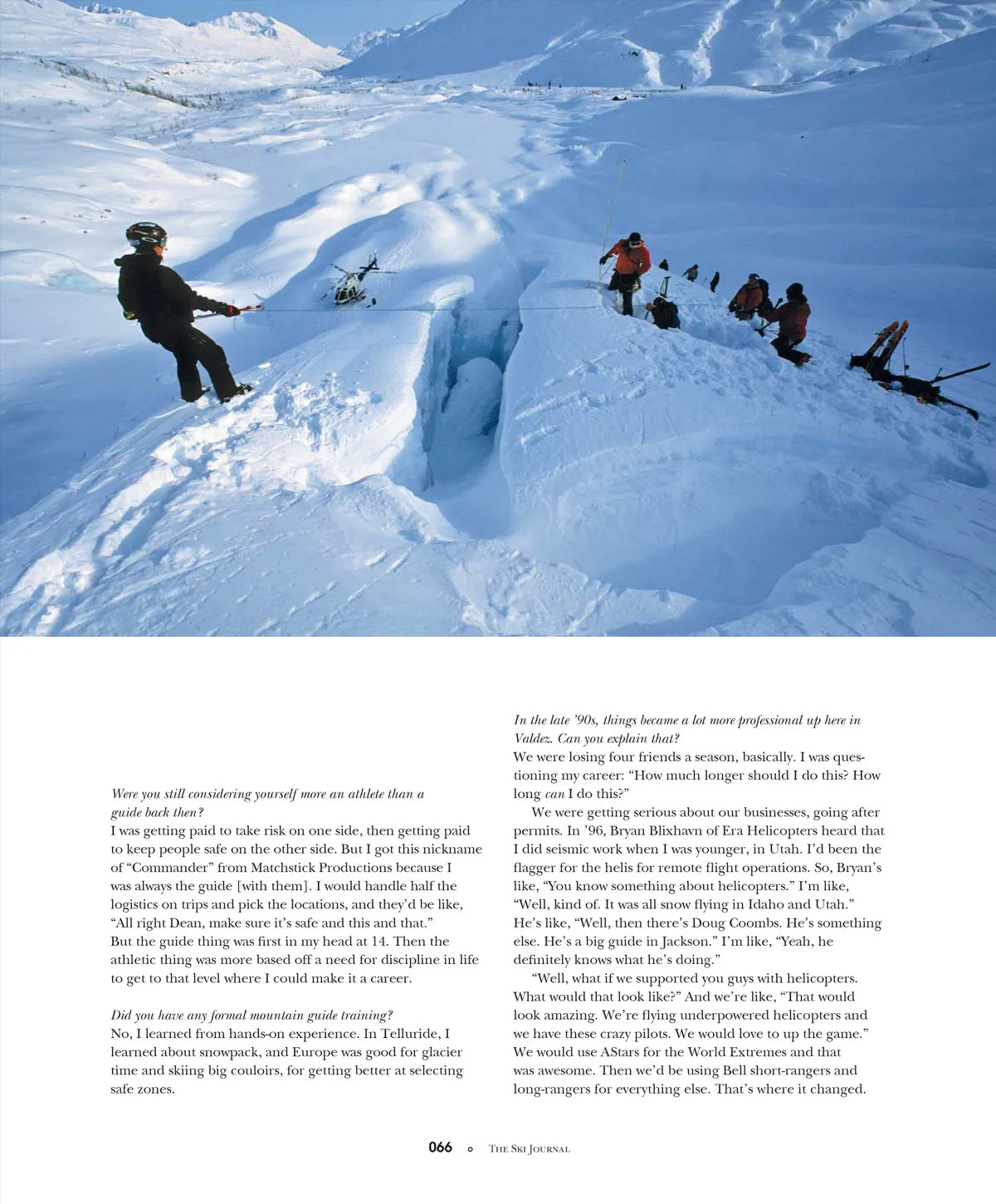
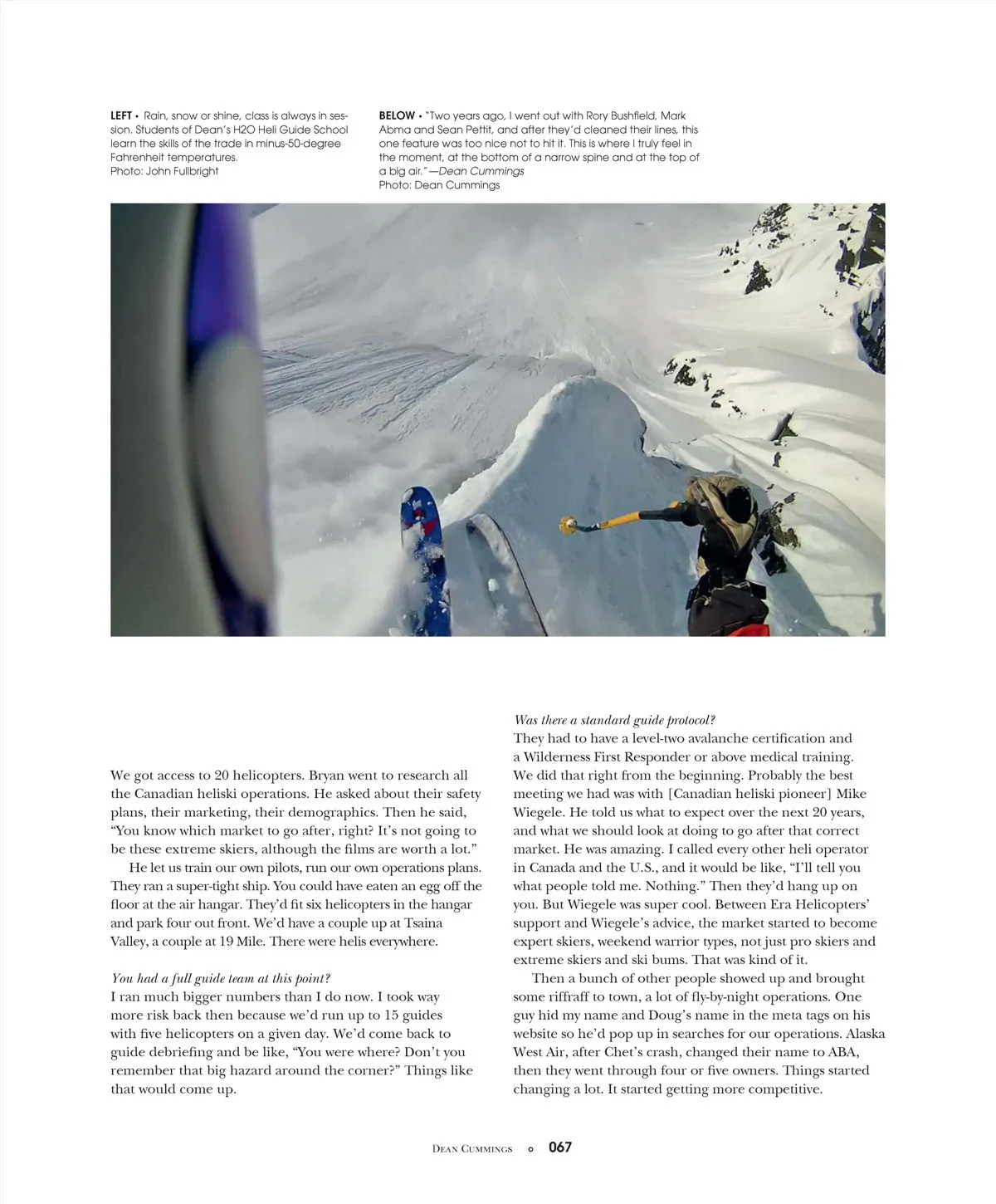
LEFT • Rain, snow or shine, class is always in ses-sion. Students of Dean’s H2O Heli Guide School learn the skills of the trade in minus-50-degree Fahrenheit temperatures. Photo: John Fullbright BELOW • “Two years ago, I went out with Rory Bushfield, Mark Abma and Sean Pettit, and after they’d cleaned their lines, this one feature was too nice not to hit it. This is where I truly feel in the moment, at the bottom of a narrow spine and at the top of a big air.” —Dean Cummings Photo: Dean Cummings We got access to 20 helicopters. Bryan went to research all the Canadian heliski operations. He asked about their safety plans, their marketing, their demographics. Then he said, “You know which market to go after, right? It’s not going to be these extreme skiers, although the films are worth a lot.” He let us train our own pilots, run our own operations plans. They ran a super-tight ship. You could have eaten an egg off the floor at the air hangar. They’d fit six helicopters in the hangar and park four out front. We’d have a couple up at Tsaina Valley, a couple at 19 Mile. There were helis everywhere. You had a full guide team at this point? I ran much bigger numbers than I do now. I took way more risk back then because we’d run up to 15 guides with five helicopters on a given day. We’d come back to guide debriefing and be like, “You were where? Don’t you remember that big hazard around the corner?” Things like that would come up. Was there a standard guide protocol? They had to have a level-two avalanche certification and a Wilderness First Responder or above medical training. We did that right from the beginning. Probably the best meeting we had was with [Canadian heliski pioneer] Mike Wiegele. He told us what to expect over the next 20 years, and what we should look at doing to go after that correct market. He was amazing. I called every other heli operator in Canada and the U.S., and it would be like, “I’ll tell you what people told me. Nothing.” Then they’d hang up on you. But Wiegele was super cool. Between Era Helicopters’ support and Wiegele’s advice, the market started to become expert skiers, weekend warrior types, not just pro skiers and extreme skiers and ski bums. That was kind of it. Then a bunch of other people showed up and brought some riffraff to town, a lot of fly-by-night operations. One guy hid my name and Doug’s name in the meta tags on his website so he’d pop up in searches for our operations. Alaska West Air, after Chet’s crash, changed their name to ABA, then they went through four or five owners. Things started changing a lot. It started getting more competitive. Dean Cummings 067
The Ski Journal Volume Eleven, Issue Three: Page 67