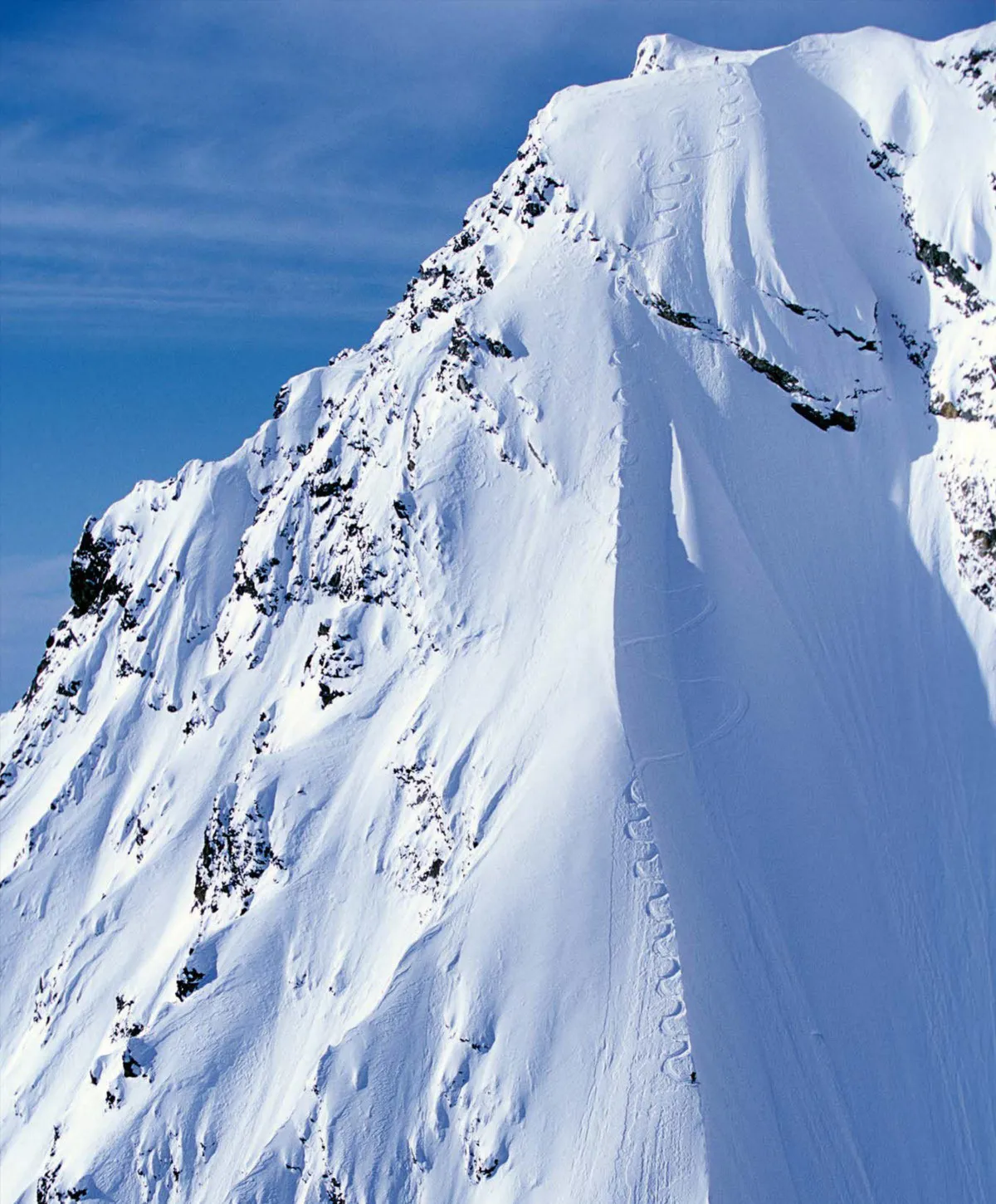
Doug and I were still chasing the permits. I ended up winning the U.S. Forest Service permit, which gave me exclusive access to all this terrain to the southeast, and it was a bummer because it affected our friendship. I only won it by a few points. The whole time I was trying to convince the USFS and Doug to just split it. There was plenty of terrain. We’d have a better safety program by sharing information. We’d have better communication systems. We’d share the cost of that. We’d share the cost of rescue caches and stuff like that. The USFS was entertaining it. But Doug and I were probably too competitive. Doug wrote some emails or had some phone calls saying the precedent has been set in the lower 48: one forest, one operator. So, they put it out as a competitive process to be given to one operator. Doug threw his hands up and was like, “I’m over this.” He went to Europe and I came to town with my operations at that point. I was sick of doing remote bases and heating helicopters out in the middle of nowhere. The Tsaina [Lodge] was falling over—it got condemned and closed up. Scott Raynor bought Coombs’ business, and in his first or second year filed Chapter 11. The pluses I took out of all that change were realizing that protocol and safety record were ultimately important, as well as providing a product that no one else has really provided around the world. What is that product? When we won the permit, I realized that we won it based on our safety record. Why don’t we minimize our risk a little bit? Why don’t we quit running so many helis and so many groups, and this will minimize our risk? If we went out to the Pencil Glacier, we would leave at 7 or 8 a.m., come home at 6 p.m., and barely get six runs. We just didn’t have it very well refined. We realized if we’re going to go to the best, safest microclimates in the range, it was time to streamline our logistics. By doing that, it’s just limiting the number of people you’re willing to take out in the mountains and the number of helicopters you want to run. I always say if you put a helicopter on the ground, that’s two guys working 16-hour days. Put another helicopter on the ground, that’s two more guys working 16-hour days. So, we’ve just been running two to three, sometimes four, helicopters for private or film jobs, but in the perfect world, I love just running one to two ships. Nowadays, it seems like we’re more of an assault team. I call it “remote mechanized guided aircraft operations” rather than heliskiing. We want to go remote and avoid doing a standard circuit like most companies do. We would rather hit an area the size of the Teton Range, and have four or five groups share that whole area. The cool thing is it could snow four feet in one spot and, not far away, it’s just two feet. We really wanted to offer a product that was a little bit different than most companies, but we weren’t even thinking about it in an entrepreneurial sense at the time. It was more like, “Well, these microclimates are serious here. How can we make the most of them?” “When I first tried skiing the Dragon’s Back off the east face of Meteorite Mountain eight years ago, conditions weren’t ideal and I wasn’t able to complete the whole spine. I got another chance in 2012, and the run won ‘Line of the Year’ at the Powder Awards. Fun fact: the face was created when a meteorite struck the mountain in 1927. It left a crater where the snow wouldn’t stick for two years.” —Dean Cummings Photo: John Fullbright We realized that setting up multiple staging areas gave us the ability to always bring our safety equipment closer to our region along with our radio communications. That safety net was everything because back in the day, we’d leave Thompson Pass and fly to the Books, then the Valley of the Tusk, then the Library and beyond. Then we’d be out beyond our means with no communication systems, no safety caches; fuel would be an hour and a half away. When we won the USFS permit, we had to get our logistics figured out and have those safety nets. When was that? And how did you reach a more refined process? In 1999, maybe. With the powder skiers showing up, we started sharing the idea that even the most moderate terrain here is just as exciting as the big ski terrain, because it’s got all these features and halfpipes and hips. If a guy wants to ski a 50-or 60-degree slope that’s only 300 feet long, he can. Even your average advanced skier could do it. We started getting the advanced intermediate, the advanced skier and the experts. The whole time we knew we needed to implement backcountry protocol. It’s more about not relying on this mechanized equipment. It’s more thinking about how everyone in the group plays a role in the outcome of the day, and everyone needs to learn that from the first briefing. Everyone needs to know more about the helicopter than just where the fire extinguisher and the pilot live. Then we started identifying the valleys and canyons and the places we knew we could ski clients to the road safely if weather came in suddenly, and not put the pilot in a situation where he felt he had to get people out of the field. We started to organize our regions based on understand-ing the wind corridors, which is critical. Thompson Pass is the worst. The Valdez Glacier is the second worst, and then the Marshall is the third worst, and the fourth is Mineral Creek. From there, we work out how much snow you’re going to get in a region, or how far the storms are going to penetrate, or where you’re going to have tension in the range from wind and where you’re not going to have it. The refinement of terrain was more based on figuring out the combination of how the storms come in, then tapping into high pressures letting loose from the interior. You can’t just be like, “Helicopter, mountain, here we go.” Dean Cummings 069
The Ski Journal Volume Eleven, Issue Three: Page 69