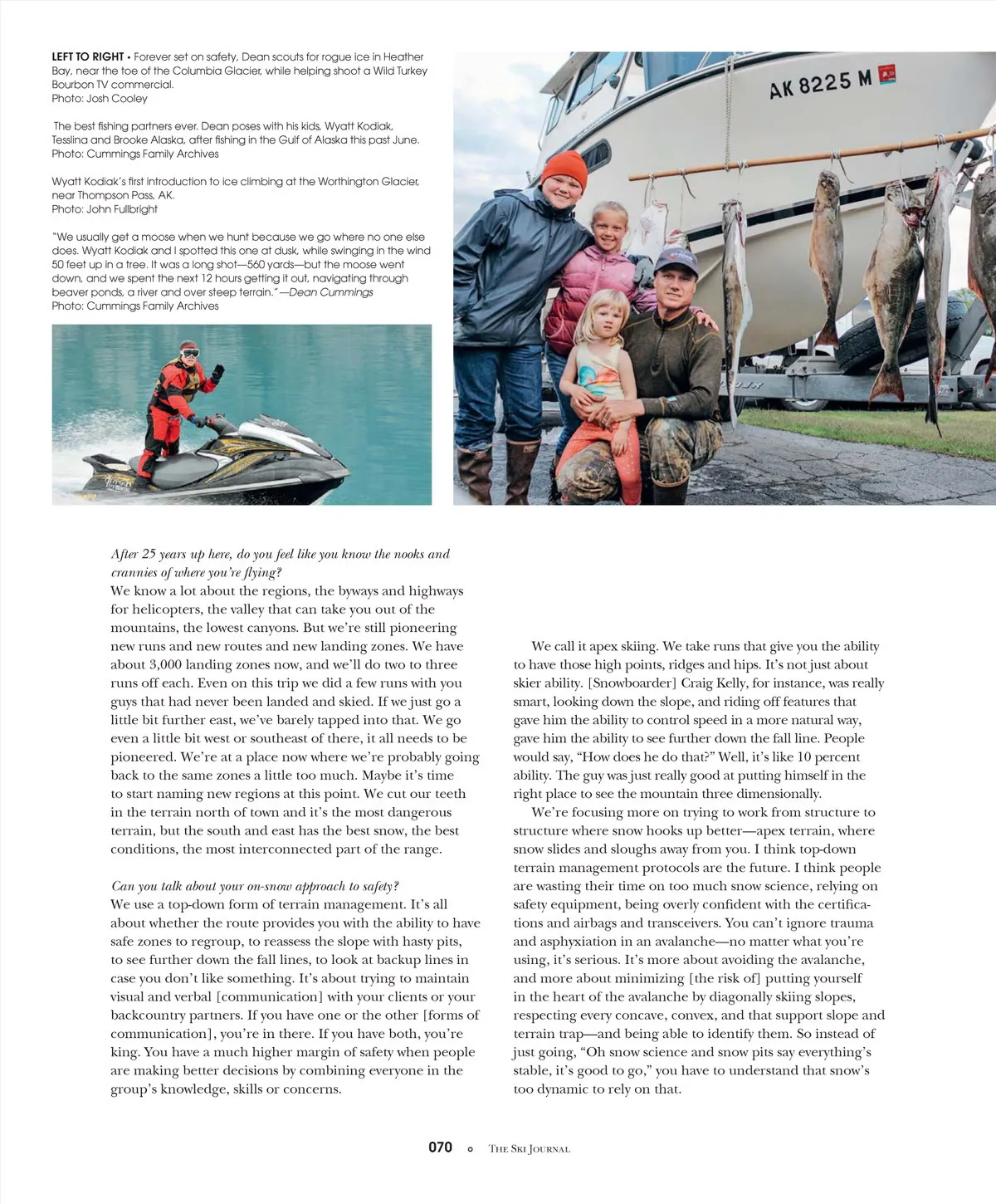
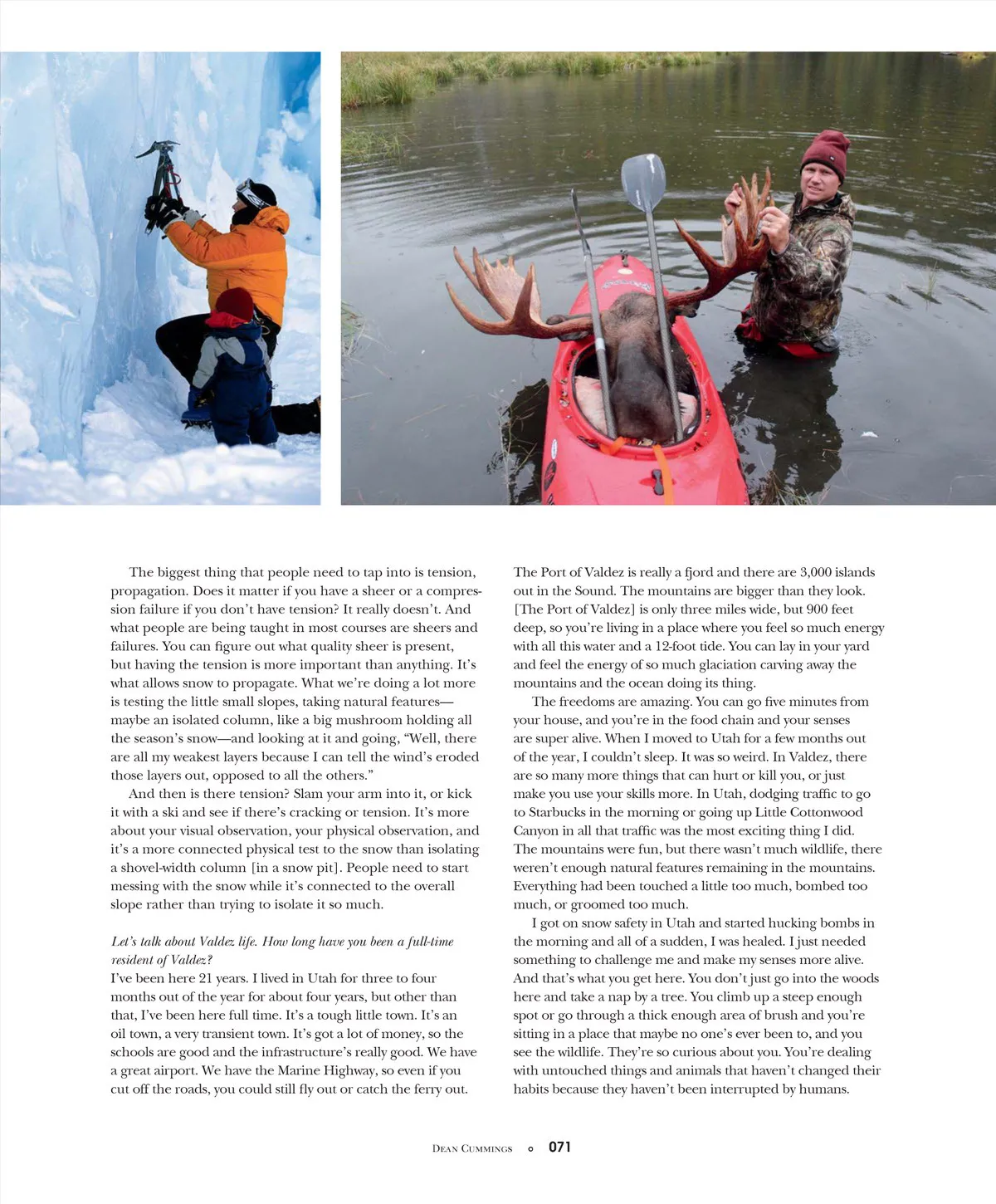
LEFT TO RIGHT • Forever set on safety, Dean scouts for rogue ice in Heather Bay, near the toe of the Columbia Glacier, while helping shoot a Wild Turkey Bourbon TV commercial. Photo: Josh Cooley The best fishing partners ever. Dean poses with his kids, Wyatt Kodiak, Tesslina and Brooke Alaska, after fishing in the Gulf of Alaska this past June. Photo: Cummings Family Archives Wyatt Kodiak’s first introduction to ice climbing at the Worthington Glacier, near Thompson Pass, AK. Photo: John Fullbright “We usually get a moose when we hunt because we go where no one else does. Wyatt Kodiak and I spotted this one at dusk, while swinging in the wind 50 feet up in a tree. It was a long shot—560 yards—but the moose went down, and we spent the next 12 hours getting it out, navigating through beaver ponds, a river and over steep terrain.” —Dean Cummings Photo: Cummings Family Archives After 25 years up here, do you feel like you know the nooks and crannies of where you’re flying? We know a lot about the regions, the byways and highways for helicopters, the valley that can take you out of the mountains, the lowest canyons. But we’re still pioneering new runs and new routes and new landing zones. We have about 3,000 landing zones now, and we’ll do two to three runs off each. Even on this trip we did a few runs with you guys that had never been landed and skied. If we just go a little bit further east, we’ve barely tapped into that. We go even a little bit west or southeast of there, it all needs to be pioneered. We’re at a place now where we’re probably going back to the same zones a little too much. Maybe it’s time to start naming new regions at this point. We cut our teeth in the terrain north of town and it’s the most dangerous terrain, but the south and east has the best snow, the best conditions, the most interconnected part of the range. Can you talk about your on-snow approach to safety? We use a top-down form of terrain management. It’s all about whether the route provides you with the ability to have safe zones to regroup, to reassess the slope with hasty pits, to see further down the fall lines, to look at backup lines in case you don’t like something. It’s about trying to maintain visual and verbal [communication] with your clients or your backcountry partners. If you have one or the other [forms of communication], you’re in there. If you have both, you’re king. You have a much higher margin of safety when people are making better decisions by combining everyone in the group’s knowledge, skills or concerns. We call it apex skiing. We take runs that give you the ability to have those high points, ridges and hips. It’s not just about skier ability. [Snowboarder] Craig Kelly, for instance, was really smart, looking down the slope, and riding off features that gave him the ability to control speed in a more natural way, gave him the ability to see further down the fall line. People would say, “How does he do that?” Well, it’s like 10 percent ability. The guy was just really good at putting himself in the right place to see the mountain three dimensionally. We’re focusing more on trying to work from structure to structure where snow hooks up better—apex terrain, where snow slides and sloughs away from you. I think top-down terrain management protocols are the future. I think people are wasting their time on too much snow science, relying on safety equipment, being overly confident with the certifica-tions and airbags and transceivers. You can’t ignore trauma and asphyxiation in an avalanche—no matter what you’re using, it’s serious. It’s more about avoiding the avalanche, and more about minimizing [the risk of] putting yourself in the heart of the avalanche by diagonally skiing slopes, respecting every concave, convex, and that support slope and terrain trap—and being able to identify them. So instead of just going, “Oh snow science and snow pits say everything’s stable, it’s good to go,” you have to understand that snow’s too dynamic to rely on that. 070 The Ski Journal
The Ski Journal Volume Eleven, Issue Three: Page 70