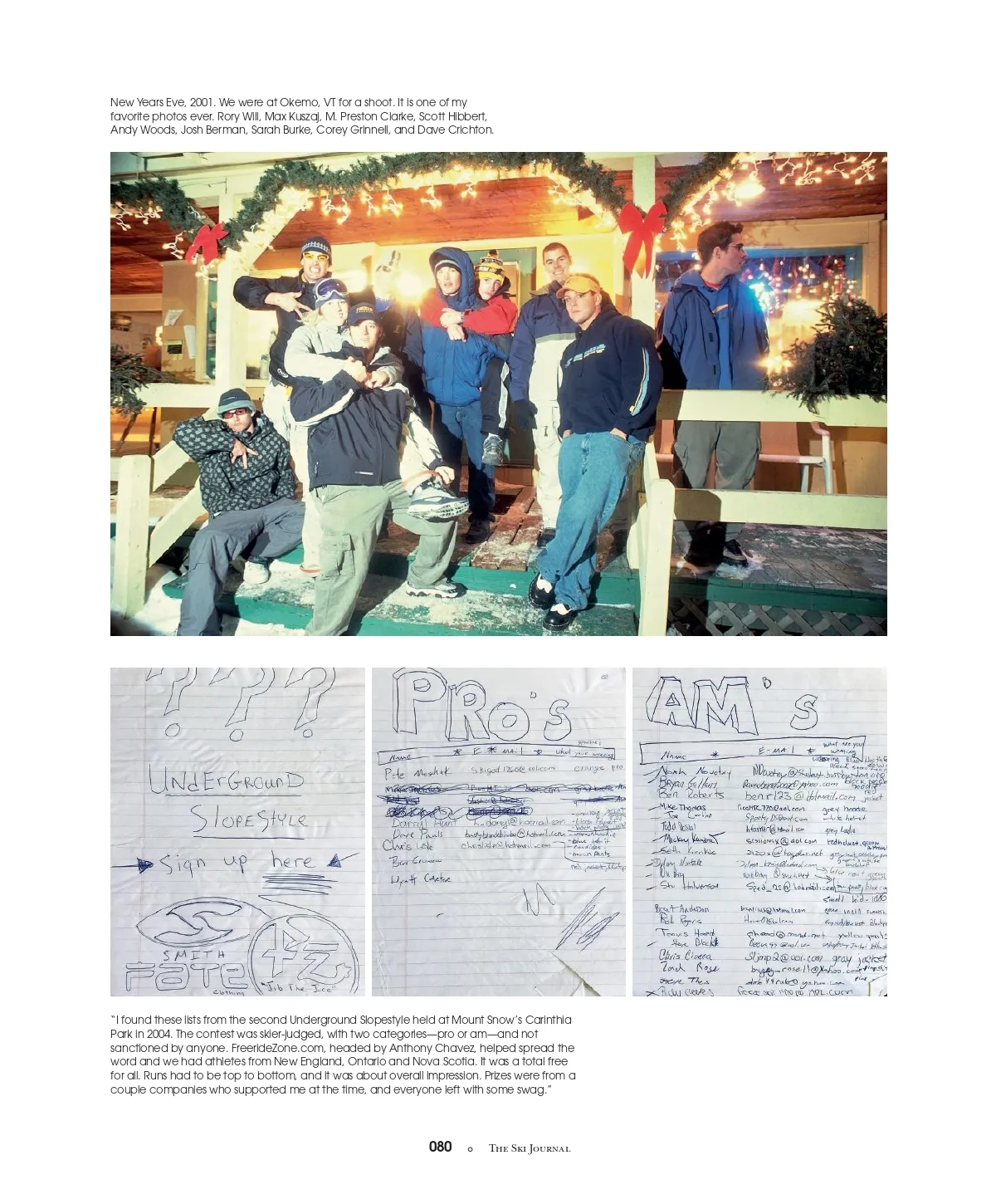
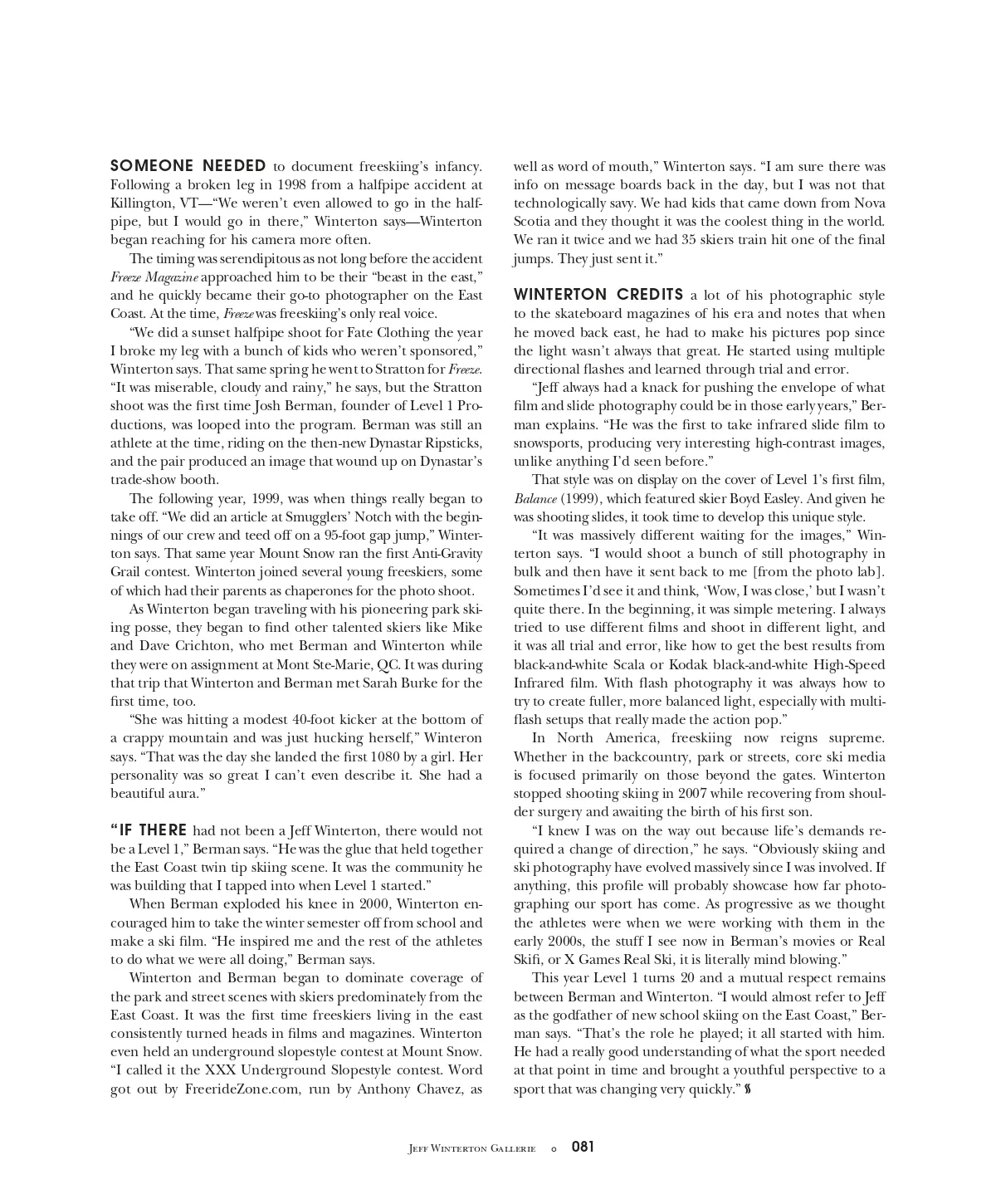
SOMEONE NEEDED to document freeskiing’s infancy. Following a broken leg in 1998 from a halfpipe accident at Killington, VT—“We weren’t even allowed to go in the half-pipe, but I would go in there,” Winterton says—Winterton began reaching for his camera more often. The timing was serendipitous as not long before the accident Freeze Magazine approached him to be their “beast in the east,” and he quickly became their go-to photographer on the East Coast. At the time, Freeze was freeskiing’s only real voice. “We did a sunset halfpipe shoot for Fate Clothing the year I broke my leg with a bunch of kids who weren’t sponsored,” Winterton says. That same spring he went to Stratton for Freeze . “It was miserable, cloudy and rainy,” he says, but the Stratton shoot was the first time Josh Berman, founder of Level 1 Pro-ductions, was looped into the program. Berman was still an athlete at the time, riding on the then-new Dynastar Ripsticks, and the pair produced an image that wound up on Dynastar’s trade-show booth. The following year, 1999, was when things really began to take off. “We did an article at Smugglers’ Notch with the begin-nings of our crew and teed off on a 95-foot gap jump,” Winter-ton says. That same year Mount Snow ran the first Anti-Gravity Grail contest. Winterton joined several young freeskiers, some of which had their parents as chaperones for the photo shoot. As Winterton began traveling with his pioneering park ski-ing posse, they began to find other talented skiers like Mike and Dave Crichton, who met Berman and Winterton while they were on assignment at Mont Ste-Marie, QC. It was during that trip that Winterton and Berman met Sarah Burke for the first time, too. “She was hitting a modest 40-foot kicker at the bottom of a crappy mountain and was just hucking herself,” Winteron says. “That was the day she landed the first 1080 by a girl. Her personality was so great I can’t even describe it. She had a beautiful aura.” “IF THERE had not been a Jeff Winterton, there would not be a Level 1,” Berman says. “He was the glue that held together the East Coast twin tip skiing scene. It was the community he was building that I tapped into when Level 1 started.” When Berman exploded his knee in 2000, Winterton en-couraged him to take the winter semester off from school and make a ski film. “He inspired me and the rest of the athletes to do what we were all doing,” Berman says. Winterton and Berman began to dominate coverage of the park and street scenes with skiers predominately from the East Coast. It was the first time freeskiers living in the east consistently turned heads in films and magazines. Winterton even held an underground slopestyle contest at Mount Snow. “I called it the XXX Underground Slopestyle contest. Word got out by FreerideZone.com, run by Anthony Chavez, as well as word of mouth,” Winterton says. “I am sure there was info on message boards back in the day, but I was not that technologically savy. We had kids that came down from Nova Scotia and they thought it was the coolest thing in the world. We ran it twice and we had 35 skiers train hit one of the final jumps. They just sent it.” WINTERTON CREDITS a lot of his photographic style to the skateboard magazines of his era and notes that when he moved back east, he had to make his pictures pop since the light wasn’t always that great. He started using multiple directional flashes and learned through trial and error. “Jeff always had a knack for pushing the envelope of what film and slide photography could be in those early years,” Ber-man explains. “He was the first to take infrared slide film to snowsports, producing very interesting high-contrast images, unlike anything I’d seen before.” That style was on display on the cover of Level 1’s first film, Balance (1999), which featured skier Boyd Easley . And given he was shooting slides, it took time to develop this unique style. “It was massively different waiting for the images,” Win-terton says. “I would shoot a bunch of still photography in bulk and then have it sent back to me [from the photo lab]. Sometimes I’d see it and think, ‘Wow, I was close,’ but I wasn’t quite there. In the beginning, it was simple metering. I always tried to use different films and shoot in different light, and it was all trial and error, like how to get the best results from black-and-white Scala or Kodak black-and-white High-Speed Infrared film. With flash photography it was always how to try to create fuller, more balanced light, especially with multi-flash setups that really made the action pop.” In North America, freeskiing now reigns supreme. Whether in the backcountry, park or streets, core ski media is focused primarily on those beyond the gates. Winterton stopped shooting skiing in 2007 while recovering from shoul-der surgery and awaiting the birth of his first son. “I knew I was on the way out because life’s demands re-quired a change of direction,” he says. “Obviously skiing and ski photography have evolved massively since I was involved. If anything, this profile will probably showcase how far photo-graphing our sport has come. As progressive as we thought the athletes were when we were working with them in the early 2000s, the stuff I see now in Berman’s movies or Real Skifi, or X Games Real Ski, it is literally mind blowing.” This year Level 1 turns 20 and a mutual respect remains between Berman and Winterton. “I would almost refer to Jeff as the godfather of new school skiing on the East Coast,” Ber-man says. “That’s the role he played; it all started with him. He had a really good understanding of what the sport needed at that point in time and brought a youthful perspective to a sport that was changing very quickly.” Jeff Winterton Gallerie 081
The Ski Journal Volume 13, Issue 2: Page 81