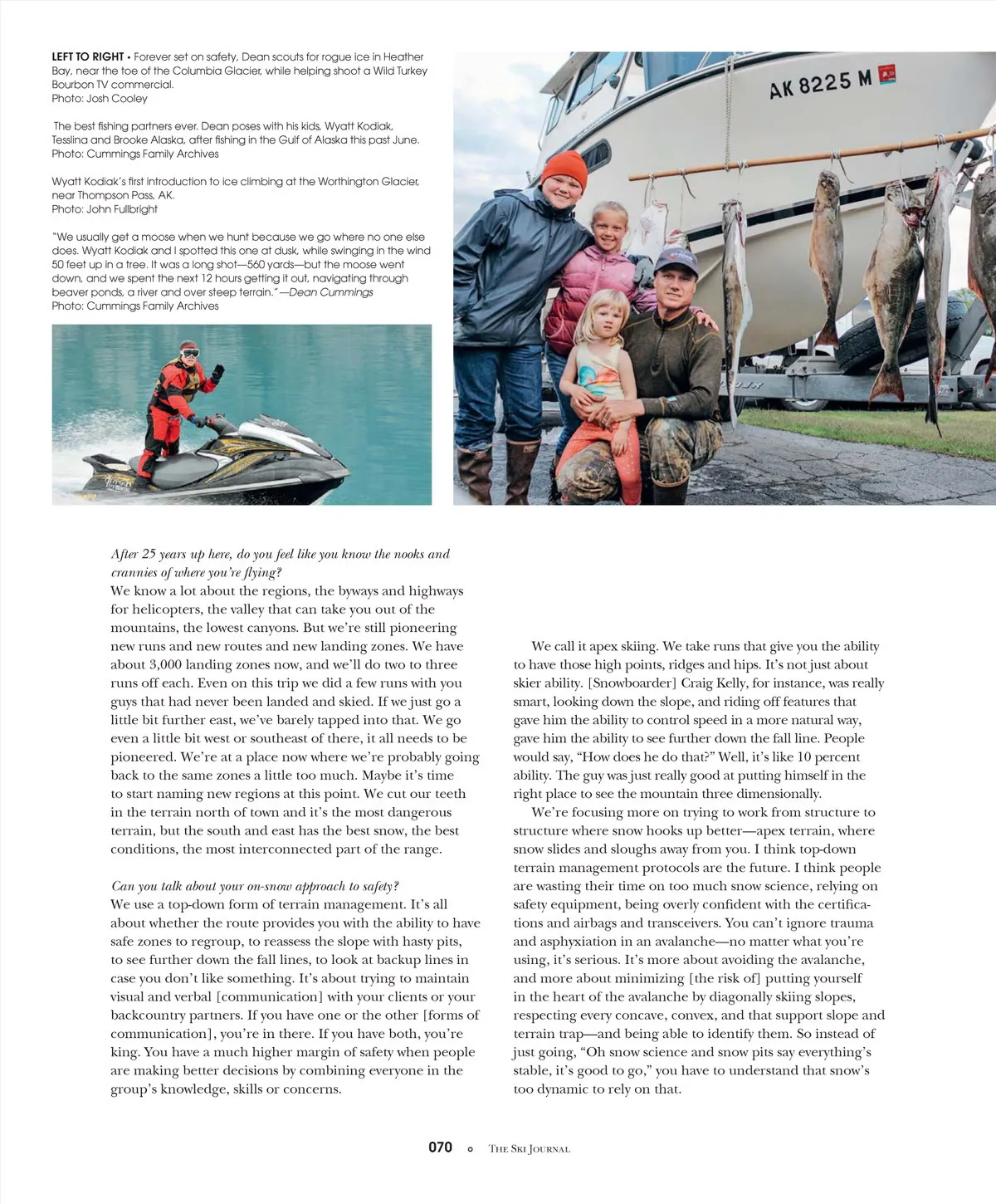
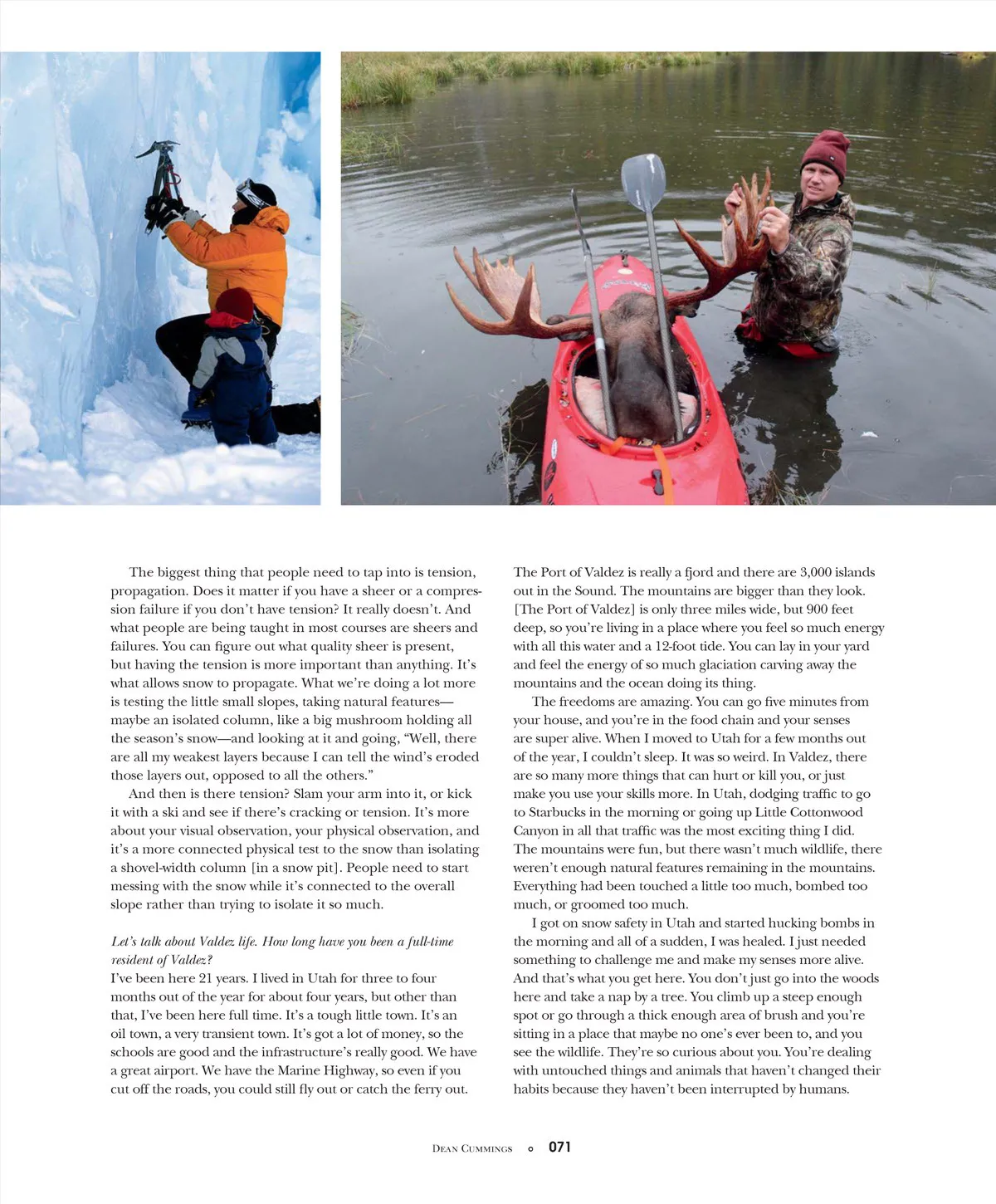
The biggest thing that people need to tap into is tension, propagation. Does it matter if you have a sheer or a compres-sion failure if you don’t have tension? It really doesn’t. And what people are being taught in most courses are sheers and failures. You can figure out what quality sheer is present, but having the tension is more important than anything. It’s what allows snow to propagate. What we’re doing a lot more is testing the little small slopes, taking natural features— maybe an isolated column, like a big mushroom holding all the season’s snow—and looking at it and going, “Well, there are all my weakest layers because I can tell the wind’s eroded those layers out, opposed to all the others.” And then is there tension? Slam your arm into it, or kick it with a ski and see if there’s cracking or tension. It’s more about your visual observation, your physical observation, and it’s a more connected physical test to the snow than isolating a shovel-width column [in a snow pit]. People need to start messing with the snow while it’s connected to the overall slope rather than trying to isolate it so much. Let’s talk about Valdez life. How long have you been a full-time resident of Valdez? I’ve been here 21 years. I lived in Utah for three to four months out of the year for about four years, but other than that, I’ve been here full time. It’s a tough little town. It’s an oil town, a very transient town. It’s got a lot of money, so the schools are good and the infrastructure’s really good. We have a great airport. We have the Marine Highway, so even if you cut off the roads, you could still fly out or catch the ferry out. The Port of Valdez is really a fjord and there are 3,000 islands out in the Sound. The mountains are bigger than they look. [The Port of Valdez] is only three miles wide, but 900 feet deep, so you’re living in a place where you feel so much energy with all this water and a 12-foot tide. You can lay in your yard and feel the energy of so much glaciation carving away the mountains and the ocean doing its thing. The freedoms are amazing. You can go five minutes from your house, and you’re in the food chain and your senses are super alive. When I moved to Utah for a few months out of the year, I couldn’t sleep. It was so weird. In Valdez, there are so many more things that can hurt or kill you, or just make you use your skills more. In Utah, dodging traffic to go to Starbucks in the morning or going up Little Cottonwood Canyon in all that traffic was the most exciting thing I did. The mountains were fun, but there wasn’t much wildlife, there weren’t enough natural features remaining in the mountains. Everything had been touched a little too much, bombed too much, or groomed too much. I got on snow safety in Utah and started hucking bombs in the morning and all of a sudden, I was healed. I just needed something to challenge me and make my senses more alive. And that’s what you get here. You don’t just go into the woods here and take a nap by a tree. You climb up a steep enough spot or go through a thick enough area of brush and you’re sitting in a place that maybe no one’s ever been to, and you see the wildlife. They’re so curious about you. You’re dealing with untouched things and animals that haven’t changed their habits because they haven’t been interrupted by humans. Dean Cummings 071
The Ski Journal Volume Eleven, Issue Three: Page 71